

Overview: what is CVE-2026-31543
The month of May 2026 has proven to be one of the most volatile periods in the history of Linux kernel security. In the wake of the “Fragnesia” disclosure, two new critical threats have emerged: CVE-2026-31543 (an information disclosure flaw in dm-crypt) and a revolutionary “FD-Theft” vulnerability that allows unprivileged users to read root-owned files.
At Limitless Hosting, we believe that transparency is the best defense. Whether you are running a cPanel shared hosting account or managing a fleet of managed VPS servers, understanding these vulnerabilities is the first step toward securing your data. In this guide, we will break down the mechanics of these flaws and provide actionable steps to keep your infrastructure safe.
What is CVE-2026-31543?
CVE-2026-31543 is a high-severity Information Disclosure vulnerability located in the Linux kernel’s crash_dump subsystem. Specifically, the flaw exists within the read_key_from_user_keying() function. This subsystem is responsible for handling kernel crashes and preparing memory dumps for analysis, but a logging oversight has turned a diagnostic tool into a security liability.
On systems where debug logging is enabled, this function inadvertently writes the first 8 bytes of sensitive dm-crypt encryption keys into the system logs (such as /var/log/kern.log or dmesg). While modern encryption keys are significantly longer, the exposure of any portion of a cryptographic key is considered a critical failure in secure coding practices.
The Technical “Root Cause”
The dm-crypt subsystem provides transparent disk encryption, ensuring that if a physical drive is stolen or a cloud instance is snapshotted, the data remains unreadable without the master key. However, developers included a hexdump logging statement within the read_key_from_user_keying() path to assist in troubleshooting key retrieval operations from the user keyring.
In production environments where debug logging is accidentally left active, or during intensive troubleshooting sessions, this statement treats the cryptographic secret as “troubleshooting data.” The kernel essentially leaks the head of the encryption key to the world.
While 8 bytes may not seem like a full compromise, it represents a massive reduction in the “entropy” or search space of the key. For a modern attacker, having the first segment of a key makes brute-forcing the remainder exponentially faster. This is particularly dangerous for those utilizing SSD KVM VPS where full-disk encryption is a standard security requirement for compliance with regulations like GDPR or HIPAA.
Attack Vector and Detection
An attacker requires local access to the system to exploit this. Once local access is gained, the attacker monitors kernel logs for key patterns. This could be done by:
- Gaining unprivileged shell access via a web vulnerability (e.g., an outdated WordPress plugin).
- Checking if
crash_dumpdebug logging is enabled. - Waiting for a system event or a manual mount of an encrypted volume that triggers the key retrieval process.
- Extracting the 8-byte fragment from
dmesgor/var/log/kern.log.
How to Mitigate CVE-2026-31543
- Disable Debug Logging: Immediately check your kernel parameters to ensure you aren’t leaking secrets.
cat /sys/module/kernel/parameters/debugIf it returns a value indicating active debug levels, disable it via your bootloader configuration or sysctl. - Restrict Log Access: Ensure that unprivileged users cannot read your kernel logs. This prevents a “low-privilege” user from seeing the leaked key bytes.
sudo chmod 640 /var/log/kern.log sudo chown root:adm /var/log/kern.log - Rotate Keys: If you find evidence of key fragments in your logs, the damage is done. You must rotate your dm-crypt keys immediately using
cryptsetup.
Transparency Is The Best Defense.
Our proactive security team doesn’t just wait for distribution updates; we monitor upstream kernel applications to provide the best support.
The Root File Access Zero-Day (The “FD-Theft” Flaw)
While CVE-2026-31543 leaks keys, a second, unnamed flaw (often associated with kernel commit 31e62c2ebbfd) allows attackers to read files they should never see, such as /etc/shadow or private SSH host keys. This is considered a “Zero-Day” because of its sudden disclosure and the reliability of the public exploits.
The Mechanics of the Race Condition: A Technical Deep Dive
This vulnerability is a textbook example of a Time-of-Check to Time-of-Use (TOCTOU) flaw. It exploits a tiny timing window during the “death” or termination phase of a privileged process.
In the Linux kernel, when a process exits (either normally or via a crash), the routine do_exit() is called. This routine is responsible for a multi-stage cleanup. Two critical stages in this sequence are:
- exit_mm(): This cleans up the process’s memory management structures (task->mm).
- exit_files(): This closes and cleans up the process’s open file descriptors (FDs).
The flaw exists because exit_mm() happens before exit_files(). For a few microseconds, a process exists in a “zombie-like” state where it has no memory (task->mm is NULL) but still holds active, open file descriptors (FDs).
Exploiting pidfd_getfd(2)
The exploit weaponizes a relatively new system call: pidfd_getfd. This syscall was designed to allow one process to “borrow” a file descriptor from another for legitimate debugging or container management purposes.
Normally, the kernel performs a “dumpable” check via the __ptrace_may_access() function to see if one process is allowed to inspect another. This check ensures that an unprivileged user cannot peek into a root process. However, the kernel’s logic contained an oversight: if a process’s memory (task->mm) is NULL, the kernel assumes the process is a kernel thread or is already gone, and it skips the dumpable check entirely.
By timing the execution of pidfd_getfd to hit that microsecond window between exit_mm() and exit_files(), an unprivileged user can “steal” an open file descriptor from a root-owned process.
Real-World Impact: Stolen Secrets
Security researchers have confirmed that this can be used against common Linux utilities that handle sensitive data:
- SSH-Keysign: An attacker can steal a file descriptor to
/etc/ssh/ssh_host_ecdsa_key. - Chage: An attacker can grab a descriptor to
/etc/shadowwhile the utility is checking password expiration. - Sensitive Configs: It can be used to access configuration files on DirectAdmin shared hosting environments that might contain database credentials or API keys.
Why This Matters for Hosting Providers
In the web hosting industry, the “sacred trust” of the kernel is what keeps users separated. The kernel is the ultimate arbiter of who can see what. When a flaw like “FD-Theft” surfaces, it undermines the very foundation of multi-tenancy.
The Risk to Multi-Tenant Environments
If you are hosting multiple clients on a single server, a vulnerability that allows “Root File Access” effectively breaks the “Limitless” promise of security. An attacker on a reseller hosting node could potentially read the /etc/shadow file of the host, use a brute-force tool to crack the password, and gain full control over every other customer on that hardware.
This is why we emphasize the benefits of choosing Limitless Hosting. Our proactive security team doesn’t just wait for distribution updates; we monitor upstream kernel mailing lists and apply mitigations before most providers even know a bug exists.
Hosting Performance vs. Security
Some providers delay patching because they fear the performance impact of kernel updates or the downtime of a reboot. However, in the current landscape, the risk of a “Zero-Day” far outweighs the inconvenience of a maintenance window.
Managing the Patching Cycle
We are seeing a “patching fatigue” in the community. Between Copy Fail, Dirty Frag, Fragnesia, and now CVE-2026-31543, administrators have had to reboot servers multiple times this month.
Automation and Efficiency
Using a billing and automation platform like Blesta or WHMCS allows you to schedule maintenance windows and notify clients about these critical security reboots automatically. This minimizes the friction of the patching process.
For enterprise-grade stability, we recommend learning to manage VPS with AI. AI-driven management can help automate the detection of unpatched kernels across thousands of nodes and even predict the best times to perform reboots based on user traffic patterns.
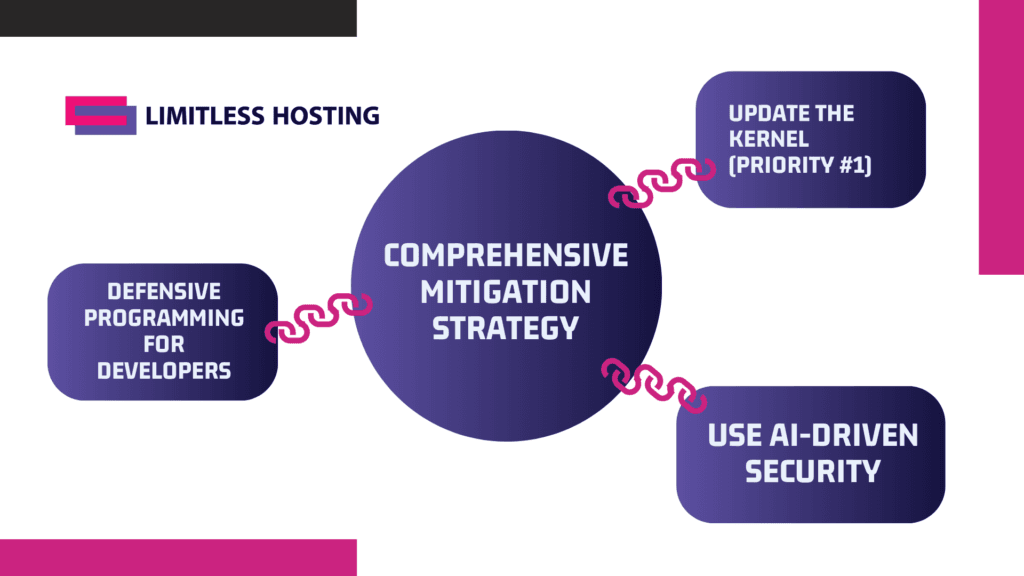
Comprehensive Mitigation Strategy
1. Update the Kernel (Priority #1)
This is the only definitive fix. Ensure your kernel includes the fix for commit 31e62c2ebbfd.
- AlmaLinux/CentOS:
yum update kernel - Ubuntu/Debian:
apt-get upgrade linux-image-generic
If you are on an unmanaged VPS, check your distribution’s security tracker for the specific version numbers that include the fix.
2. Defensive Programming for Developers
If you develop privileged utilities or SetUID binaries, you must adopt defensive practices:
- O_CLOEXEC: Always use this flag when opening files to ensure descriptors aren’t leaked.
- Close Early: Close sensitive FDs immediately after they are no longer needed.
- Privilege Dropping: Ensure that privileges are dropped as early as possible in the process lifecycle.
3. Use AI-Driven Security
By integrating tools like AI domain monitoring with Aepto, you can monitor for unauthorized system changes or anomalous behavior. While these tools are great for domains, the same AI-driven logic is being applied to server-side EDR (Endpoint Detection and Response) to catch attackers trying to exploit the “FD-Theft” race condition.
Conclusion: A New Standard for Linux Security
The vulnerabilities of May 2026 have shown that even 6-year-old bugs can lie dormant in the Linux kernel until the right researcher finds them. Whether it is a key leak in CVE-2026-31543 or a race condition in process termination, the lesson is clear: Prompt patching is not optional.
Stay vigilant, keep your systems updated, and rely on a host that puts security at the forefront of its mission.
FAQs
1. Does CVE-2026-31543 affect my website data?
Only if your server uses dm-crypt for full-disk encryption and has debug logging enabled. If so, your encryption keys could be partially leaked, making your data vulnerable to offline attacks if the disk is ever compromised.
2. What is an “FD-Theft” vulnerability?
It is a flaw where an attacker “steals” an open file handle (File Descriptor) from a privileged process (like root) just as it is closing, allowing them to read files they shouldn’t have access to, like the shadow file or SSH keys.
3. Is my Shared Hosting account safe?
If you are on our cPanel shared hosting or DirectAdmin hosting, our admins have already applied the necessary kernel patches and hardened the nodes. You are protected.
4. How do I know if my VPS is vulnerable?
Run uname -r. If your kernel version is older than May 14, 2026, you should check your distribution’s security advisory for the 31e62c2ebbfd fix.
5. Why are so many Linux bugs appearing now?
As tools like AI domain monitoring and advanced fuzzing become more common, researchers are able to find complex race conditions that were previously invisible to manual auditing.
6. Do I need to rotate my SSH keys?
If you suspect your server was exploited using the FD-theft flaw before you patched, yes. Attackers could have potentially read your private host keys and could use them for “Man-in-the-Middle” attacks later.
7. What is the best way to prevent reboots?
Consider live-patching services like KernelCare, which apply these fixes to the running kernel memory without requiring a full system restart, maintaining your uptime.
Latest posts:
- How Aepto Browser Extension Can Help You Understand a Website’s Hosting Stack
- CloudFest 2025 and Its Impact on Web Hosting & Cloud Infrastructure
- How Long Do Web Hosting Anniversary Discounts Last?
- Why Domain Monitoring Matters for Brand Protection
- Why Do People Attend CloudFest? 10 Reasons the Internet Infrastructure Community Shows Up