
In the modern digital landscape, the security of data in transit is a non-negotiable pillar of online trust. Every time a consumer submits a credit card transaction, an enterprise syncs database volumes across a cloud environment, or a user logs into a web panel, cryptographic systems work silently behind the scenes to block eavesdroppers and hijackers. The universal standard for establishing these encrypted pathways is Secure Sockets Layer (SSL) and its modern, hardened successor, Transport Layer Security (TLS).
While public attention often centers on the high-profile asymmetric handshake, where servers exchange certificates and negotiate keys, the actual heavy lifting of continuous data transmission is handled by a lower-level, highly structured subsystem: the Record Protocol in SSL.
Operating as the foundational transport wrapper of the SSL/TLS stack, the Record Protocol is responsible for taking raw application data (such as HTTP traffic) and converting it into secure, authenticated, and verified cryptographic payloads. If this layer is misconfigured, unpatched, or running on obsolete hardware, your entire security perimeter collapses, exposing your applications to deep security exploits.
This comprehensive guide explores the layered architecture of SSL/TLS, the technical mechanics of the SSL Record Protocol, its operational step-by-step pipeline, and how choosing high-performance web servers ensures that intensive cryptographic operations do not degrade your website’s performance.
Key Takeaways
Before diving into the technical mechanics, here is an executive summary of the SSL Record Protocol’s role:
- The Core Carrier: The Record Protocol is the lower-level workhorse of the SSL/TLS suite, responsible for encapsulating all upper-layer data into formatted cryptographic blocks.
- Dual Security Pillars: It guarantees two primary security services: Confidentiality (via symmetric encryption) and Integrity (via Message Authentication Codes).
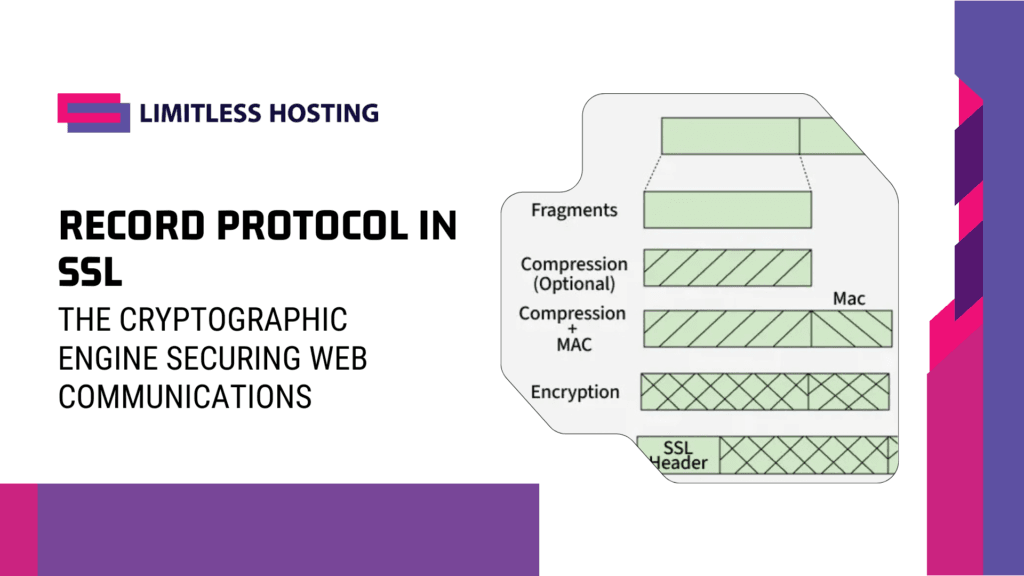
- The Structured Pipeline: Data undergoes a strict, sequential pipeline: Fragmentation, Compression (now deprecated), MAC calculation, Encryption, and Header Prep.
- Modern AEAD Defense: Modern TLS implementations have phased out vulnerable “Encrypt-then-MAC” sequences in favor of Authenticated Encryption with Associated Data (AEAD) to eliminate padding oracle attacks.
- Performance Overhead: Cryptographic encapsulation is highly processor-intensive. Running high-volume SSL workloads requires optimized, bare-metal CPU architectures to prevent server latency.
1. The Layered Architecture of SSL/TLS
To understand where the Record Protocol sits, we must analyze the structural architecture of the Secure Sockets Layer. SSL/TLS is not a single, monolithic protocol. Instead, it is a layered suite of protocols operating between the Application Layer (Layer 7) and the Transport Layer (Layer 4) of the OSI model.
+-----------------------------------------------------------------------------+
|  SSL Handshake   |  SSL Change Cipher Spec  |  SSL Alert   |  HTTP (App)    |  <-- Upper Layer
+-----------------------------------------------------------------------------+
|                          SSL Record Protocol                                |  <-- Lower Layer (Carrier)
+-----------------------------------------------------------------------------+
|                                  TCP                                        |  <-- Transport Layer
+-----------------------------------------------------------------------------+
|                                  IP                                         |  <-- Network Layer
+-----------------------------------------------------------------------------+
As illustrated above, the SSL stack is divided into two primary layers:
The Upper Layer Protocols
The upper layer consists of three SSL-specific management protocols and the application data protocol itself:
- SSL Handshake Protocol: Responsible for negotiating cryptographic capabilities (cipher suites), authenticating the server (and optionally the client), and establishing the shared symmetric keys.
- SSL Change Cipher Spec Protocol: A single-byte signaling protocol that transitions the state of the connection from unencrypted to encrypted mode.
- SSL Alert Protocol: Communicates warning and fatal alert messages (e.g., handshake failures or bad certificates) to the peer.
- Application Data Protocol: The raw payload being transmitted, such as HTTP (forming HTTPS), SMTP, or FTP.
The Lower Layer: The SSL Record Protocol
The SSL Record Protocol sits directly beneath these upper-layer protocols. It acts as the carrier layer, taking data from any of the upper-layer protocols, formatting it, applying cryptographic transformations, and feeding the resulting records into the reliable transmission stream of TCP.
Without the Record Protocol, the handshake would have no secure envelope to transmit its negotiated parameters, and application data would flow across the network in cleartext. Understanding this structural partition is a critical foundation for security engineers transitioning from theory to practice in cyber security.
2. Core Services Offered by the Record Protocol in SSL
The Record Protocol provides two primary cryptographic services to ensure that data in transit remains secure:
Confidentiality (Privacy)
To ensure that unauthorized third parties cannot read the contents of your web traffic, the Record Protocol uses symmetric encryption. Unlike asymmetric encryption (which is computationally slow and used only during the handshake to negotiate keys), symmetric encryption is highly efficient and capable of encrypting gigabytes of active data in real-time.
The symmetric keys used by the Record Protocol are negotiated dynamically during the Handshake phase. The protocol supports various symmetric block and stream ciphers, including:
- AES (Advanced Encryption Standard): Running in GCM (Galois/Counter Mode) or CBC (Cipher Block Chaining) modes.
- ChaCha20: Combined with the Poly1305 authenticator, forming a highly efficient, modern alternative for mobile devices lacking hardware-accelerated AES instructions.
Message Integrity (Authenticity)
Confidentiality is useless if an attacker can alter the encrypted data mid-transit without being detected. If a malicious actor intercepts an encrypted packet and flips specific bits (a bit-flipping attack), they can alter transactions or inject malicious payloads.
To guarantee message integrity, the Record Protocol calculates a Message Authentication Code (MAC) or a Hash-based MAC (HMAC) using a shared secret key. When a record is received, the target host recalculates the MAC. If the computed MAC does not match the transmitted MAC, the record is discarded, and the connection is terminated with a fatal Alert protocol trigger. This prevents replay attacks, injection exploits, and data corruption.
Limitless Speed, Unbeatable Value.
Fast, Reliable Shared Hosting Starting at Just $0.50/Month!
3. The Step-by-Step Operational Pipeline
When an application layer protocol passes data down to the SSL Record Protocol, the data undergoes a strict, sequential transformation pipeline before it is written to the TCP socket.
[ Application Plaintext ]
       ➔ [ Step 1: Fragmentation (Split into <= 16KB blocks) ]
       ➔ [ Step 2: MAC Generation (HMAC computation) ]
       ➔ [ Step 3: Symmetric Encryption (Plaintext + MAC + Padding) ]
       ➔ [ Step 4: Header Encapsulation (Type, Version, Length) ]
       ➔ [ Final Encrypted SSL Record sent to TCP ]
Step 1: Fragmentation
The first step is fragmentation. The Record Protocol cannot process infinitely large streams of data in a single run. It splits the incoming application data into manageable blocks.
According to the official SSL/TLS specification, each fragment must be:
- Less than or equal to $2^{14}$ bytes (exactly 16,384 bytes, or 16 KB).
- Non-empty (except for specific TLS 1.1/1.2 padding implementations used to mitigate BEAST attacks).
Step 2: Compression (Deprecated/Historically)
Historically, the second step was compressing the fragmented blocks using a negotiated compression algorithm (such as DEFLATE) to save network bandwidth.
Note: In modern TLS (including TLS 1.2 and TLS 1.3), compression is completely disabled. Security researchers discovered that attackers could monitor the size of encrypted packets to deduce secrets if the plaintext was compressed before encryption, a family of vulnerabilities known as the CRIME and BREACH attacks. Consequently, modern hosts skip this step entirely.
Step 3: Computing the Message Authentication Code (MAC)
Next, the protocol computes a cryptographic checksum over the fragmented plaintext. To prevent replay attacks, the calculation incorporates a 64-bit sequence number ($Seq$) that increments with every packet sent.
Let $P$ represent the plaintext fragment, $K_{mac}$ represent the shared MAC secret key, $Type$ represent the upper-layer protocol type, and $Length$ represent the length of the fragment. We can mathematically model the traditional HMAC-SHA256 calculation as:$$\text{MAC} = \text{HMAC}_{K_{mac}}(Seq \parallel Type \parallel Version \parallel Length \parallel P)$$
By including the sequence number ($Seq$) inside the hash computation, the protocol ensures that an attacker cannot capture a valid encrypted packet and re-transmit it later, as the receiver’s expected sequence number will have incremented, causing a MAC verification failure.
Step 4: Symmetric Encryption
Once the MAC is calculated, it is appended to the plaintext fragment. If the chosen symmetric cipher is a block cipher (like AES in CBC mode), the protocol also appends padding bytes to ensure the total length of the payload is a multiple of the cipher’s block size (typically 16 bytes).
The entire combined block, Plaintext ($P$), MAC, and Padding, is then encrypted using the shared symmetric encryption key ($K_{enc}$):$$C = E_{K_{enc}}(P \parallel \text{MAC} \parallel Padding)$$
where $C$ represents the resulting ciphertext and $E$ represents the symmetric encryption function.
The Shift to AEAD (Authenticated Encryption with Associated Data)
In older SSL/TLS versions, the “MAC-then-Encrypt” sequence shown above was the standard. However, this sequence was vulnerable to highly sophisticated padding oracle attacks, such as the POODLE and Lucky Thirteen exploits. Attackers could analyze slight timing differences in how a server rejected packets with bad padding versus packets with bad MACs to slowly decrypt the ciphertext.
To eliminate this vulnerability, modern TLS 1.3 utilizes AEAD (Authenticated Encryption with Associated Data) ciphers (such as AES-GCM or ChaCha20-Poly1305). AEAD ciphers combine encryption and authentication into a single, unified mathematical operation. There is no separate padding step or independent MAC calculation, removing the entire attack surface of padding oracle exploits.
Step 5: Prepending the Record Header
The final step is encapsulating the encrypted ciphertext ($C$) by prepending a static, 5-byte SSL Record Header. This header contains the metadata required by the receiving host to correctly parse, decrypt, and route the record:
+------------------+------------------+------------------+----------------------+
| Content Type (1) | Major Version (1)| Minor Version (1)| Compressed Length (2)|  <-- 5-Byte Header
+------------------+------------------+------------------+----------------------+
|                                 Ciphertext Payload                            |  <-- Variable Length
+-------------------------------------------------------------------------------+
The header consists of four distinct fields:
- Content Type (8 bits): Identifies which upper-layer protocol generated the payload.
20(Hex0x14): Change Cipher Spec21(Hex0x15): Alert Protocol22(Hex0x16): Handshake Protocol23(Hex0x17): Application Data
- Major Version (8 bits): Identifies the major version of the SSL/TLS protocol being used (e.g.,
3for SSL 3.0 or TLS 1.0/1.1/1.2/1.3 legacy fields). - Minor Version (8 bits): Identifies the minor version (e.g.,
3for TLS 1.2 or legacy TLS 1.3 compatibility headers). - Compressed/Plaintext Length (16 bits): Defines the exact length of the ciphertext payload in bytes. A 16-bit field allows for a maximum payload size of $2^{16} – 1$ bytes, though the actual fragmentation limit restricts this to approximately $2^{14} + 2048$ bytes to accommodate encryption expansion.
Once the header is attached, the complete SSL Record is passed down to the TCP socket for physical transmission across the network.
4. Why Cryptographic Overhead Matters for Web Hosts
While the SSL Record Protocol ensures robust security, it does not come for free. Encrypting and decrypting every single packet of web traffic places a continuous, intensive computational load on your web server’s central processing unit (CPU).
The Math of Encryption Latency
Each record received by your server requires several processor-intensive operations:
- Header Parsing: Reading the 5-byte metadata wrapper.
- Symmetric Decryption: Running AES or ChaCha20 decryption mathematics over the ciphertext blocks.
- MAC Verification: Executing HMAC hash iterations or AEAD tag verifications.
- Buffer Reconstruction: Reassembling the 16 KB fragments back into a contiguous application stream.
If your website receives a sudden surge of traffic, your web server must process thousands of these cryptographic operations concurrently. On under-powered, unoptimized, or over-allocated virtual machines, this high cryptographic overhead can saturate the CPU, leading to slow page loads, database timeouts, and server crashes.
To ensure your server can handle the high-speed cryptographic requirements of modern HTTPS without degrading the user experience, selecting the right hosting platform is essential. For corporate landing pages, high-traffic blogs, and local business sites, beginning with a fast, secure cPanel shared hosting plan is a highly cost-effective starting point. Our shared environments utilize optimized LiteSpeed web servers and CPU resource limits to process SSL transactions smoothly without resource lag.
However, as your business grows and your concurrent active connections scale, your cryptographic requirements will increase. To prevent server degradation and maintain the near-zero latency required for real-time transactions, transitioning to isolated, dedicated hardware allocations is highly recommended. For growing agencies and scaling developers, choosing high-performance virtual servers built on VPS hosting nodes ensures you have the dedicated CPU threads and memory lanes required to handle intensive cryptographic encryptions easily, keeping your web pages fast and secure.
5. Security Synergies: Infrastructure and Domain Safety
Securing your online business is a multi-dimensional challenge. While the SSL Record Protocol keeps your data encrypted and authenticated between the browser and the server, your digital presence is only as secure as the infrastructure that powers it and the domains that direct users to it.
THE DEFENSE-IN-DEPTH ENCRYPTED ROUTE:
[ Secure Domain DNS ] ➔ [ SSL Record Protocol Envelope ] ➔ [ Hardened Web Server Infrastructure ]
Hardening the Server Layer (Limitless Hosting)
Symmetric encryption on the server requires rock-solid hardware. Dedeploying your applications on an enterprise-grade virtual platform like our SSD KVM VPS guarantees absolute hardware isolation. Our servers are built on top of high-performance AMD EPYC and Ryzen processors, which feature native AES-NI (Advanced Encryption Standard New Instructions) hardware acceleration. This allows the CPU to execute the mathematical steps of the SSL Record Protocol directly at the silicon level, reducing encryption overhead by up to 400% compared to legacy processors.
To keep costs lean while managing multiple client sites, many modern developers are abandoning bloated, expensive control panels and deploying their virtual private servers with lightweight solutions. Opting for a streamlined panel setup, such as our managed VPS servers powered by lightweight control software, saves valuable RAM and CPU cycles, leaving your server resources free to process actual web traffic and cryptographic operations.
Securing the Domain Layer (Aepto Partner Integration)
Even if your server-side SSL encryption is completely unbreakable, your brand remains vulnerable if your domain name itself is hijacked. If an attacker gains unauthorized access to your registrar account or manipulates your external DNS records, they can simply point your domain to their own malicious servers. They can then generate their own valid Let’s Encrypt SSL certificates, completely bypassing your local security layers and intercepting your customer traffic.
To eliminate this critical security blind spot, enterprise-grade operations must pair server-side encryption with proactive, domain-level security monitoring.
By integrating your hosting with specialized brand-protection tools from Aepto, you build an impenetrable, multi-layered shield. Implementing Aepto’s advanced domain protection & theft guard protocols ensures that your domain registration remains locked at the registry level. While Aepto watches for unauthorized DNS modifications, nameserver drifts, and registry-level transfer attempts, Limitless Hosting ensures your backend data is processed on fast, secure, and hardened hardware, creating a unified defense-in-depth shield for your business.
6. How to Optimize Your Server for SSL Record Performance
To ensure your web server delivers maximum cryptographic performance and minimal latency, implement the following server-side optimization strategies:
Enable TLS 1.3
TLS 1.3 is the latest version of the Transport Layer Security protocol. It completely removes obsolete, vulnerable cryptographic algorithms (such as RC4, 3DES, and AES-CBC) and mandates the use of modern, high-speed AEAD ciphers. TLS 1.3 also slashes handshake latency from two round-trips to one, significantly accelerating connection times.
Configure HTTP/2 or HTTP/3 (QUIC)
The SSL Record Protocol’s 16 KB fragmentation limit can sometimes lead to network congestion on slow connections due to head-of-line blocking. Enabling HTTP/2 or HTTP/3 multiplexing allows your server to transmit multiple streams of encrypted data concurrently over a single TCP or UDP connection, maximizing bandwidth efficiency.
Implement OCSP Stapling
During the handshake, the visitor’s browser must verify that your SSL certificate has not been revoked. Normally, this requires the browser to query the Certificate Authority (CA) directly, adding latency. OCSP Stapling allows your server to fetch the signed revocation status from the CA periodically and “staple” it directly to the SSL record during the handshake, saving your visitors a round-trip connection.
Enable Session Resumption (Session Tickets)
If a user returns to your website, they should not have to execute the entire processor-heavy asymmetric handshake again. Session Resumption allows the server and client to reuse previously negotiated cryptographic keys from an active session, allowing the SSL Record Protocol to resume encrypting data instantly.
SSL Record Protocol Head-to-Head Comparison
| Feature / Metric | Legacy SSL 3.0 / TLS 1.0 Record | Modern TLS 1.2 Record | Cutting-Edge TLS 1.3 Record |
|---|---|---|---|
| Symmetric Encryption | Stream (RC4), Block (3DES) | Block (AES-CBC), AEAD (AES-GCM) | AEAD-Only (AES-GCM, ChaCha20) |
| Integrity Check | HMAC (MD5, SHA-1) | HMAC (SHA-256), AEAD Tag | Integrated AEAD Authentication |
| Data Compression | Supported (Vulnerable to CRIME) | Supported (Typically Disabled) | Completely Forbidden / Removed |
| Padding Oracle Vulnerability | Highly Vulnerable (POODLE) | Partially Vulnerable (Lucky 13) | Immune (AEAD-only architecture) |
| Cryptographic Overhead | Medium | High (Due to separate HMAC/Crypt steps) | Low (Optimized hardware-level AEAD) |
Conclusion: Build a Fast, Secure Digital Foundation
The SSL Record Protocol is the unsung hero of internet security, acting as the robust carrier that protects our digital transactions, emails, and web data from prying eyes. From the initial fragmentation of raw data to the complex math of symmetric encryption and header encapsulation, the protocol ensures that every packet sent across the web arrives intact, authenticated, and completely confidential.
As cyber threats become more sophisticated and user expectations for speed continue to rise, running a secure website requires more than just installing a basic SSL certificate. It requires a deep, technical commitment to server optimization, hardware acceleration, and domain-level safety.
At Limitless Hosting, we provide the high-performance, SSD-powered hardware, redundant networks, and managed security support needed to process intensive cryptographic operations smoothly. Choose a secure foundation, pair your hosting with advanced domain intelligence, and build an online presence that is fast, resilient, and truly limitless.
Frequently Asked Questions (FAQs)
1. What is the main difference between the SSL Handshake Protocol and the SSL Record Protocol?
The SSL Handshake Protocol operates at the upper layer of the SSL stack and is responsible for establishing the connection parameters, authenticating the server, and negotiating the shared symmetric keys. The SSL Record Protocol operates at the lower layer, acting as the carrier that actually encrypts, authenticates, and transmits the active application data using the keys negotiated during the handshake.
2. Why is data compression disabled in modern SSL/TLS Record implementations?
Compression was disabled because of the CRIME and BREACH security vulnerabilities. These attacks exploit a logical relationship between compression and encryption: because compressed data is smaller when there are repeating patterns, an attacker monitoring the size of encrypted packets could slowly deduce secret cookies or tokens by injecting known text into the application stream and watching how the record size changed.
3. How does AEAD encryption improve the security of the SSL Record?
AEAD (Authenticated Encryption with Associated Data) ciphers (such as AES-GCM) perform encryption and integrity verification in a single, unified mathematical operation. This eliminates the older, two-step “MAC-then-Encrypt” sequence, which was highly vulnerable to padding oracle attacks (like POODLE and Lucky Thirteen) where attackers used subtle server timing differences to decrypt data.
4. What is the maximum size of an SSL Record fragment?
According to the official SSL/TLS specifications, the maximum plaintext size of a single SSL Record fragment is $2^{14}$ bytes (exactly 16,384 bytes, or 16 KB). This fragmentation ensures that servers can process and decrypt data in predictable blocks without consuming excessive system memory buffers.
5. Why do older browser versions sometimes fail to load modern HTTPS pages?
Older browsers often lack support for the modern cryptographic algorithms mandated by newer protocols. For example, TLS 1.3 completely removes legacy, weak ciphers (like 3DES and RC4). If an old browser cannot negotiate a modern AEAD cipher supported by the server, the SSL Record Protocol cannot establish an encrypted envelope, causing the connection to fail.
6. How does domain hijacking threaten my SSL-secured website?
SSL only encrypts the traffic between the user and the destination server IP defined by your DNS. If an attacker hijacks your domain or manipulates your DNS settings, they can point your domain to their own malicious server. They can then generate a valid, free SSL certificate for your domain name, tricking your users and intercepting their encrypted data, highlighting the critical importance of independent domain protection & theft guard systems.
Latest Posts:
- How Aepto Browser Extension Can Help You Understand a Website’s Hosting Stack
- CloudFest 2025 and Its Impact on Web Hosting & Cloud Infrastructure
- How Long Do Web Hosting Anniversary Discounts Last?
- Why Domain Monitoring Matters for Brand Protection
- Why Do People Attend CloudFest? 10 Reasons the Internet Infrastructure Community Shows Up