
CloudFest can look unusual from the outside. It is a major technology event, but it is not simply a conventional trade show where people walk around booths, collect brochures, and return home. It brings together cloud service providers, web hosting companies, managed service providers, enterprise IT teams, cybersecurity professionals, software companies, open-source contributors, agencies, developers, and technology decision-makers in one place.
So why do people attend CloudFest?
The answer is more practical than the name might suggest. People attend because several of their professional goals can be handled at the same event: learning what is changing in internet infrastructure, meeting partners, comparing products, finding customers, exchanging technical ideas, discovering new opportunities, and building relationships that are difficult to create through email or video calls alone.
CloudFest’s own 2026 attendee profile reports more than 10,900 participants, 236 speakers, 238 partners, and attendees from 87 countries. It also reports that the leading reasons people gave for attending were industry knowledge, discovering new products and services, and building partnerships. Those figures help explain why CloudFest has become a recurring meeting point for the wider internet infrastructure ecosystem.
This guide breaks down the main reasons people attend CloudFest and what different types of professionals can realistically get from the experience.
What Is CloudFest Really For?
At its core, CloudFest is a place where the companies and professionals who build, operate, secure, sell, and depend on internet infrastructure can meet each other. The event combines conference sessions, exhibitions, workshops, demonstrations, networking, community activities, and social events.
That combination matters because internet infrastructure is not one isolated technology. A website may depend on domains, DNS, storage, compute, networking, cybersecurity, email, databases, content delivery, virtualization, monitoring, automation, and multiple service providers. A decision in one layer can affect the others.
CloudFest gives professionals an opportunity to look at that broader ecosystem instead of evaluating every part of it in isolation. For some attendees, the value is educational. For others, it is commercial. For others, it is simply the chance to meet the people behind the platforms they already use.
1. To Learn What Is Changing in Internet Infrastructure
One of the clearest reasons people attend CloudFest is knowledge. Technology changes too quickly for infrastructure professionals to rely only on what they already know.
Cloud platforms, virtualization, storage, server hardware, AI workloads, cybersecurity, data regulations, automation, observability, and energy efficiency are all moving targets. Even when a company is not changing its stack immediately, its technical and business teams need to understand where the market is heading.
CloudFest concentrates that information into a short period. Instead of spending months collecting scattered articles, product announcements, webinars, and vendor briefings, an attendee can hear multiple perspectives in one environment.
This is especially useful when a trend is moving from experimentation toward real-world adoption. AI is a strong example. Hosting companies and infrastructure operators are not just asking what AI can do; they are also thinking about compute demand, power consumption, data governance, storage requirements, networking, security, and the effect of AI on existing hosting businesses.
For readers who want a practical starting point on that broader shift, our guide to how AI is impacting web hosting explores several of the infrastructure changes businesses are already considering.
2. To Meet People They Could Not Easily Reach Online
Email is useful. Video calls are useful. Social networks are useful. None of them completely replace a face-to-face conversation.
CloudFest attracts people from companies that may otherwise interact only through tickets, procurement teams, partner portals, or short online meetings. Putting those people in the same physical environment lowers the barrier to communication.
A fifteen-minute hallway conversation can sometimes clarify a technical or commercial question faster than a week of back-and-forth email. A developer can explain an integration problem directly to a product team. A hosting company can talk to a platform provider. A reseller can meet a service partner. A buyer can compare approaches with several vendors before deciding which conversations deserve a formal follow-up.
The important point is that networking at CloudFest is not limited to formal introductions. People meet while moving between sessions, during meals, in exhibition spaces, at community gatherings, and at social events. That makes the event valuable even for attendees who do not arrive with a large list of scheduled meetings.
3. To Discover New Products and Services
Another major reason people attend is simple: they want to see what is new.
A cloud or hosting professional can spend weeks evaluating products from different vendors. CloudFest compresses that discovery process by putting many companies into the same ecosystem at roughly the same time.
Attendees can compare infrastructure providers, control panels, security products, backup platforms, monitoring systems, hardware, software, cloud services, networking solutions, and other tools. Product demonstrations are also easier to evaluate when questions can be asked immediately.
This can be valuable for both technical and commercial teams. An engineer may be looking for a more efficient operational tool, while a business leader may be looking for a service that can improve margins, reduce support workload, or create a new product line.
CloudFest also creates a useful distinction between a product that looks good in marketing material and a product that performs well under detailed questions. Face-to-face conversations let attendees ask about deployment, scaling, compatibility, support, licensing, security, roadmap decisions, and real operational trade-offs.
Ready to Get Your Website Online?
Fast, reliable web hosting from Limitless Hosting. Explore our plans and find the right fit for your site.
4. To Build Partnerships and Business Opportunities
Partnerships are one of the strongest reasons people return to industry events.
Internet infrastructure businesses depend on ecosystems. A hosting company may work with a control-panel vendor, payment platform, domain registrar, security provider, backup provider, data-center operator, software company, agency network, or cloud platform. A large enterprise may have a completely different set of dependencies, but it still relies on a network of technology partners.
CloudFest provides a concentrated opportunity to identify those relationships and turn them into practical conversations.
Partnership discussions can cover many forms: reseller agreements, integrations, referrals, distribution, infrastructure sourcing, technology alliances, strategic relationships, and joint projects. Not every conversation becomes a deal, and that is normal. The value is often in discovering who is worth continuing a conversation with after the event.
For agencies and infrastructure businesses, this can be particularly useful when they are deciding whether to build everything themselves or combine specialist services from multiple providers. A healthy partner ecosystem can reduce duplicated effort and help a company deliver more without expanding every internal function.
5. To Hear From Decision-Makers and Industry Leaders
People also attend CloudFest because they want context from the people making major decisions in the industry.
Conference sessions, panels, keynotes, and discussions can reveal how leaders think about changes that may affect customers months or years before the impact becomes obvious in day-to-day operations.
For a technical audience, the value is not simply hearing a famous name speak. The more useful outcome is understanding why companies are making certain infrastructure, security, product, or business decisions.
That perspective can help attendees ask better questions inside their own organizations. Should a team invest in more automation? Is a new architecture actually solving a customer problem? Which emerging technology deserves a pilot? Which infrastructure costs are likely to rise? Where are regulations or security expectations changing?
These are strategic questions, and an event such as CloudFest can help technical teams connect them to wider industry conversations.
6. To Explore AI, Sustainability, Security, and Other Big Industry Themes
People rarely attend CloudFest just to discuss yesterday’s technology. They are usually looking for signals about what the next stage of infrastructure will require.
In 2026, one of the event’s major themes was the sustainability of everything. That framing extends the sustainability conversation beyond energy use and into the long-term viability of infrastructure businesses, technology models, jobs, and trust.
That wider perspective matters because infrastructure decisions increasingly have several dimensions at once. AI can improve automation and create new services, but it can also increase compute demand. Security can reduce risk, but it requires ongoing investment. High-performance infrastructure can improve applications, but it can also increase operating costs if it is badly optimized.
CloudFest gives attendees room to evaluate those trade-offs with people who approach them from different parts of the ecosystem.
That is useful for a hosting operator deciding how to invest in servers, a developer deciding what architecture to adopt, a vendor planning its product roadmap, or a business executive trying to understand where the next source of infrastructure cost might appear.
7. To Solve Real Problems Through Open Source and the Hackathon
CloudFest is also attractive to people who prefer building over simply listening.
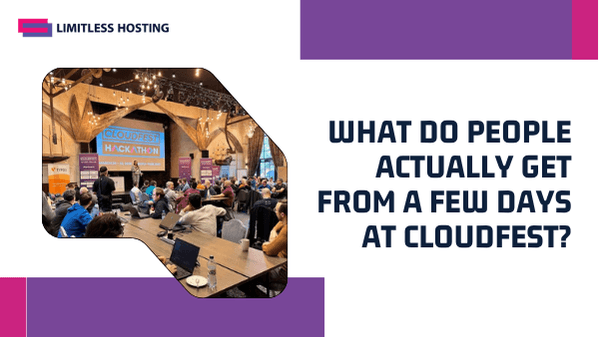
The event has a strong open-source component, including its Hackathon, where developers and other contributors work together on projects and practical problems. Open-source participation changes the nature of the event because attendees can move from discussing problems to experimenting with solutions.
For developers, this can be one of the most valuable ways to attend. They can meet other contributors, test ideas, learn unfamiliar workflows, and contribute to projects outside their normal environment.
For companies, the open-source ecosystem also provides a way to understand how technologies are actually being used by technical communities. That can inform product decisions, integrations, documentation, and hiring.
8. To Compare Vendors, Platforms, and Service Providers in One Place
Technology purchasing is rarely about finding a product with the longest feature list. Compatibility, support, pricing, performance, migration effort, operational overhead, and vendor reliability often matter just as much.
CloudFest gives buyers a chance to compare these factors across multiple conversations.
For example, a company evaluating infrastructure may want to know how different options handle scaling, backups, network performance, control-panel compatibility, incident response, or resource isolation. A business evaluating a platform may care about licensing and support just as much as features.
Face-to-face comparison can also expose differences that are difficult to see on product pages. The quality of technical explanations, the depth of answers, and the willingness to discuss edge cases can all help an attendee decide which vendors deserve deeper technical validation after the event.
The final decision should still be based on proper testing and commercial due diligence. CloudFest can improve the shortlist; it does not replace evaluation.
9. To Strengthen Brands and Professional Networks
CloudFest is not only about buyers and technical teams. Companies attend because they want to be visible in the ecosystem.
For an established provider, the event can reinforce relationships with existing customers and partners. For a smaller company or startup, it can provide exposure to people who may never discover the business through ordinary online marketing.
Professional visibility also matters for individuals. Engineers, product managers, founders, sales professionals, developers, and consultants can expand their professional networks by meeting peers from other regions and specialties.
That network can continue to create value long after the event. A person met during a conference may later become a customer, employer, partner, technical advisor, investor, collaborator, or referral source.
The best way to think about that value is not as immediate lead generation but as relationship building. A strong network becomes more useful over time.
10. To Experience a Different Kind of Industry Event
The atmosphere is another reason people attend.
CloudFest is held at Europa-Park in Rust, Germany, rather than in a traditional conference venue. The event combines technical programming with an environment designed to encourage informal interaction, including rides, social events, food, and parties.
That setting is not just a novelty. It can influence how people communicate. Conversations that might feel formal in a conference room can become more relaxed when they happen while walking between activities or sharing a meal.
This matters because relationships are easier to build when people have time to interact as people rather than as job titles. In infrastructure, where contracts, integrations, support agreements, and long-term partnerships can depend heavily on trust, that human element can be valuable.
Who Attends CloudFest—and Why Their Goals Differ
CloudFest is broad enough that the same event can solve different problems for different people.
| Attendee type | Common reason for attending | Typical outcome |
|---|---|---|
| Web hosting companies | Partnerships, vendors, infrastructure trends | New suppliers, integrations, channel relationships |
| Cloud service providers | Market intelligence and business development | New customers and strategic relationships |
| Enterprise IT teams | Technology research and peer learning | Better understanding of tools and architectures |
| MSPs and agencies | Services, partnerships, and customer opportunities | New offerings or delivery partners |
| Developers | Open source, technical sessions, networking | Knowledge, collaborators, and project experience |
| Startups | Brand exposure, partnerships, and customers | Introductions to decision-makers and ecosystem partners |
| Vendors | Product visibility and channel relationships | Demos, leads, partner discussions, market feedback |
This diversity is one of the event’s biggest practical strengths. People are not attending for exactly the same reason, but their goals overlap enough to create useful conversations.
What Do People Actually Get From a Few Days at CloudFest?
The biggest benefit of CloudFest is usually not one keynote, one booth, or one meeting. It is the combination of many smaller outcomes that become useful when they are connected.
An infrastructure engineer may leave with three ideas for improving operations. A founder may meet a potential technology partner. A sales leader may discover a new market segment. A developer may find an open-source project that solves a problem on the roadmap. An enterprise IT manager may narrow down a list of vendors worth testing.
CloudFest’s 2026 attendee profile gives a useful snapshot of what people themselves say they want from the event: 33% cited industry knowledge, 32% wanted to discover new products and services, and 30% cited partnerships as a primary motivation. Those goals overlap heavily, which is why a single conversation can have both technical and commercial value.
There is also a longer-term outcome: context. After talking to people from different parts of the ecosystem, attendees often return to work with a better sense of how their own company fits into the larger internet infrastructure market.
That context can improve decisions long after the event ends.
For organizations responsible for many domains and online services, that same need for visibility continues after the conference. An AI-driven platform such as Aepto’s smart domain insights can help centralize domain signals and surface issues across a larger portfolio.
How to Prepare for CloudFest So the Time Pays Off
Attending a large industry event without a plan can become expensive sightseeing. The professionals who get the most value usually decide in advance what they want to learn, who they want to meet, and which problems they want to investigate.
Define Three Clear Goals
Choose a small number of outcomes, such as finding two potential partners, evaluating a new infrastructure category, or learning how other companies handle a specific operational problem. A short goal list is easier to execute than a vague intention to “network.”
Research the Companies You Want to Meet
Do not wait until you reach the exhibition floor to discover who is there. Identify vendors, platforms, prospective partners, and relevant communities before the event. A little preparation creates much better conversations.
Bring Real Questions
Real operational questions are more valuable than generic sales conversations. Ask about migration paths, compatibility, performance, support, scaling, licensing, security, and the edge cases that matter to your organization.
Leave Space for Unexpected Conversations
A completely booked calendar can be just as limiting as having no plan. The person you did not expect to meet may become the most valuable connection of the event, so leave time for informal networking and spontaneous discussions.
Follow Up While the Conversation Is Fresh
CloudFest creates introductions; follow-up creates relationships. Record what you discussed, agree on a next step where appropriate, and contact people soon after returning home. A useful event is measured by what continues afterward.
More broadly, good infrastructure decisions still depend on fundamentals such as speed, reliability, security, and the right hosting architecture. Resources such as our guide to fast website loading speed and our overview of VPS hosting can help teams connect conference ideas to practical infrastructure choices.
Conclusion
People attend CloudFest because it compresses many parts of the internet infrastructure industry into one place. They go to learn, compare technologies, meet peers, find partners, discover products, discuss business opportunities, contribute to open source, and understand where the market is heading.
CloudFest’s value is therefore bigger than its schedule. The sessions provide information, the exhibition provides product discovery, the community provides relationships, and the setting creates opportunities for conversations that might never happen through ordinary digital channels.
For hosting companies like Limitless Hosting, cloud providers, enterprise IT teams, agencies, developers, and technology vendors, that combination can turn a few days away from the office into months of useful ideas and new relationships.
And that is ultimately why people keep attending: not because there is only one thing to get from CloudFest, but because a single trip can solve several professional problems at once.
Frequently Asked Questions
Why do people attend CloudFest instead of online webinars?
Online events are convenient, but CloudFest combines learning with face-to-face networking, demonstrations, informal conversations, and access to many different parts of the internet infrastructure ecosystem at the same time. That combination is difficult to reproduce in a webinar.
Is CloudFest only for large cloud companies?
No. CloudFest attracts a broad mix of cloud service providers, web hosters, MSPs, enterprise IT teams, web agencies, developers, vendors, startups, and open-source contributors. Smaller providers can attend to build partnerships, meet customers, research technology, and expand their industry network.
Do technical people benefit from CloudFest?
Yes. Technical attendees can use the event to learn from other practitioners, evaluate products, discuss architecture and operations, explore emerging technologies, and participate in open-source activities. The best value often comes from bringing specific technical questions to the event.
Is CloudFest mainly a networking event?
Networking is a major part of CloudFest, but it is not the only purpose. The event also provides keynotes, breakout sessions, masterclasses, exhibition spaces, product discovery, technical discussions, and community activities.
What should a first-time CloudFest attendee prepare?
A first-time attendee should set a few clear goals, research relevant companies and sessions, prepare specific questions, schedule priority meetings where possible, and still leave room for informal conversations. A follow-up plan is also important because the value of new connections usually develops after the event.
Where is CloudFest held?
CloudFest Global is held at Europa-Park in Rust, Germany. The setting is part of the event’s identity because the venue combines the technical program with informal networking and social activities.
Latest Posts from our blog:
- Why Domain Monitoring Matters for Brand Protection
- Why Do People Attend CloudFest? 10 Reasons the Internet Infrastructure Community Shows Up
- What Is CloudFest? A Guide to the World’s Internet Infrastructure Event
- How Many Websites Can Shared Hosting Handle?
- Low Latency Web Hosting: How Server Location and Infrastructure Affect Website Speed