
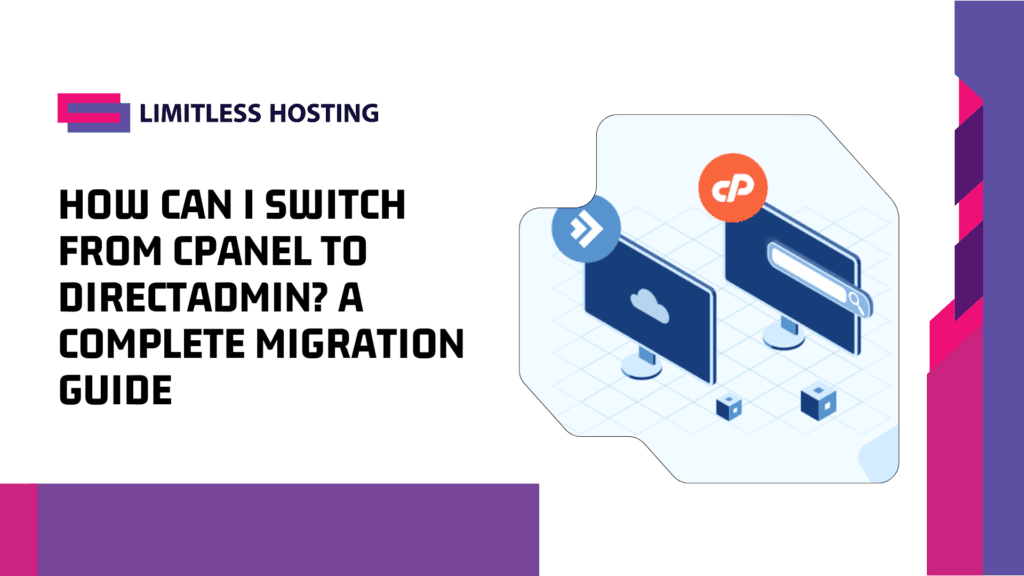
Asking yourself, How Can I Switch from cPanel to DirectAdmin? Switching from cPanel to DirectAdmin can be a smart move if you want a modern hosting control panel, lower licensing costs, or a simpler server management experience. However, moving from one control panel to another is more than simply changing the login URL. Your website files, databases, email accounts, DNS records, SSL certificates, cron jobs, and other hosting configurations all need to be transferred and tested correctly.
The good news is that switching from cPanel to DirectAdmin is entirely possible, and the migration can usually be completed with minimal disruption when it is planned properly.
In this guide, we’ll explain how to switch from cPanel to DirectAdmin, what you need before starting, how the migration works, what can go wrong, and how to verify that everything is working after the move.
Why Switch from cPanel to DirectAdmin?
cPanel has been one of the most widely used Linux hosting control panels for years. However, hosting providers and website owners increasingly consider alternatives because of licensing costs, server resource requirements, interface preferences, and changes in hosting economics.
DirectAdmin provides many of the same core hosting-management functions while maintaining a relatively lightweight architecture.
Some common reasons for switching include:
- Lower control-panel licensing costs
- A lightweight control panel with relatively low resource overhead
- A modern interface
- Support for common hosting features
- Easier management of websites, domains, databases, email, and DNS
- A suitable environment for shared, reseller, and VPS hosting
- Greater flexibility for hosting providers managing their infrastructure
If you’re already considering DirectAdmin, understanding what DirectAdmin hosting is and how it works can help you decide whether it fits your requirements.
Is DirectAdmin a Replacement for cPanel?
Yes. DirectAdmin can replace cPanel for many common hosting environments.
| Feature | cPanel | DirectAdmin |
|---|---|---|
| Website files | Yes | Yes |
| MySQL/MariaDB databases | Yes | Yes |
| Email accounts | Yes | Yes |
| DNS management | Yes | Yes |
| SSL certificates | Yes | Yes |
| Cron jobs | Yes | Yes |
| Domain management | Yes | Yes |
| Subdomains | Yes | Yes |
| FTP accounts | Yes | Yes |
| Reseller management | Yes | Yes |
| VPS/server management | Yes | Yes |
The important point is that the migration transfers your hosting data and configuration; it does not simply convert the cPanel installation into DirectAdmin.
Can You Migrate Directly from cPanel to DirectAdmin?
In many cases, yes.
DirectAdmin provides migration functionality designed to help administrators move accounts from other control panels, including cPanel.
For a typical migration, the process looks like this:
- Prepare the new DirectAdmin server.
- Back up the cPanel accounts.
- Create or configure the DirectAdmin environment.
- Transfer the account data.
- Restore websites and databases.
- Migrate email accounts and configurations.
- Verify DNS and SSL settings.
- Test the websites before changing DNS.
- Point domains to the new server.
- Monitor the migration and resolve any remaining issues.
The exact migration process depends on your server configuration, operating system, PHP versions, mail stack, database versions, and the type of hosting account being moved.
What Should You Check Before Migrating?
Do not start the migration immediately.
First, create an inventory of everything currently running on the cPanel server.
For every account, identify:
- Primary domains
- Addon domains
- Subdomains
- Website files
- Databases
- Database users
- Email accounts
- Email forwarders
- DNS records
- SSL certificates
- Cron jobs
- FTP accounts
- PHP versions
- PHP extensions
- Custom configuration files
- WordPress installations
- Application-specific settings
- Redirects
- Scheduled tasks
- Any third-party integrations
This inventory gives you something to compare against after the migration.
Blazing Fast Direct Admin Hosting
Get the speed your website deserves with storage and optimized server resources.
Check Your PHP and Application Requirements
One of the easiest migration problems to overlook is software compatibility.
A website may work perfectly on cPanel because the old server provides a particular PHP version or extension that isn’t enabled on the DirectAdmin server.
Before migrating, document:
- Current PHP version
- Required PHP extensions
- Database version
- Web server configuration
- Required system libraries
- WordPress version
- Plugin requirements
- Framework requirements
- Custom PHP settings
This is especially important for WordPress, WooCommerce, Laravel, Magento, and custom applications.
Step 1: Choose and Prepare the DirectAdmin Server
You need a properly configured DirectAdmin server before moving your websites.
For example, you might use a VPS if you need more control over the operating system, web server, PHP configuration, and other services. If you’re unsure about the resources required, a guide on how much VPS RAM you need can help with initial capacity planning.
Before beginning the migration, make sure the new server has:
- DirectAdmin installed
- A supported operating system
- Sufficient disk space
- Enough RAM and CPU capacity
- Correct hostname configuration
- Proper DNS configuration
- Required PHP versions
- Required database software
- Mail services configured
- Firewall and security controls configured
- Valid network connectivity
- A dedicated or appropriately configured IP address
Do not migrate a production website to a server that has not been tested.
Step 2: Back Up Your cPanel Accounts
Never start a control-panel migration without a reliable backup.
Your backup should give you a recovery option if the migration fails.
Your backup should account for website files, databases, email, and DNS records. For WordPress, this includes the database containing posts, pages, users, settings, comments, plugin data, and WooCommerce information.
Email migration deserves special attention. Make sure you account for mailboxes, forwarders, aliases, autoresponders, mail filters, mail routing, and existing messages.
A website can appear to migrate successfully while users discover later that old emails are missing.
DNS Records
Record important DNS entries before changing nameservers. These may include A, AAAA, MX, CNAME, TXT, SPF, DKIM, DMARC, and verification records.
If your domain uses external services such as Google Workspace, Microsoft 365, CDNs, payment systems, or SaaS applications, make sure their DNS records are preserved.
Step 3: Create the Migration Package
The next step is to prepare the cPanel account data for transfer.
Depending on the migration method and server setup, you may use cPanel account backups or DirectAdmin’s migration tools.
A typical cPanel account contains much more than the public website directory. A proper migration should preserve the account structure and supporting services wherever the target environment supports them.
The migration should account for home directory files, databases, database users, email data, DNS zones, domain configuration, SSL information, cron jobs, FTP accounts, and account-level settings.
Step 4: Import the Accounts into DirectAdmin
Once the DirectAdmin server is ready, transfer the migration packages to the destination server.
DirectAdmin can then process the migration and recreate the corresponding accounts.
During this stage, pay attention to account usernames, domain names, disk usage, database names, database users, email accounts, DNS zones, file ownership, and permissions.
Do not immediately delete anything from the cPanel server. Keep the old environment available until you’ve confirmed that the new DirectAdmin environment works correctly.
Step 5: Verify Website Files
After the account has been migrated, check the website files carefully.
For a WordPress website, verify that wp-config.php contains the correct database information, wp-content is intact, plugins and themes are present, uploaded images are present, .htaccess rules are correct, and file permissions are appropriate.
For custom applications, check application-specific configuration files and environment variables.
Step 6: Verify Databases
Database problems are among the most common causes of migration-related website errors.
Check that the database exists, the database user exists, the user has the required permissions, the database credentials match the application configuration, tables are present, the expected database size is approximately correct, and the application can establish a connection.
For WordPress, an incorrect database name, username, password, or host can result in an error establishing a database connection.
Step 7: Check Email Migration
Email is one of the areas where migration planning matters most.
After importing an account, check existing mailboxes, old messages, folder structure, forwarders, autoresponders, email passwords, mail filters, SMTP settings, and IMAP/POP3 settings.
Send test messages in both directions: an external address to the migrated mailbox, and the migrated mailbox to an external address.
Step 8: Reconfigure DNS
DNS is critical during the final migration stage.
Your domain needs to resolve to the new DirectAdmin server. Depending on your setup, you may either change nameservers or update the domain’s A/AAAA records.
Before changing DNS, verify that the new server is fully prepared.
Pay particular attention to MX records because changing them incorrectly can interrupt email delivery. Also preserve important TXT records used for SPF, DKIM, DMARC, domain verification, and third-party services.
Step 9: Install and Verify SSL Certificates
Once the website is resolving to the new server, verify HTTPS.
Test both the root domain and the www version. Make sure HTTP redirects correctly to HTTPS if that is your intended configuration.
Check for a valid certificate, correct domain names, no certificate warnings, no mixed-content problems, and correct redirect behavior.
If you need a deeper understanding of certificates during hosting migrations, understanding what an SSL certificate chain is can help when troubleshooting certificate-related issues.
Step 10: Test the Website Before Going Live
Do not rely solely on the migration tool’s success message.
A successful migration means the data was transferred. It doesn’t necessarily mean the application works exactly as it did before.
Front-End Testing
Open the homepage, main navigation, important landing pages, contact pages, product pages, blog posts, search pages, images, and downloads.
WordPress Testing
For WordPress, also test the WordPress admin area, login, publishing, media uploads, plugin functionality, theme functionality, forms, WooCommerce checkout, payment integrations, and scheduled tasks.
Database Testing
Perform actions that require database access, such as submitting a form, creating a test user, publishing a test post, adding a product to a cart, or performing a test database operation.
Step 11: Test Cron Jobs and Scheduled Tasks
Cron jobs are easy to forget during a control-panel migration.
Review every scheduled task on the cPanel server. Common examples include WordPress scheduled tasks, backups, application queues, report generation, database maintenance, API synchronization, and automated scripts.
Make sure each job exists on the DirectAdmin server and uses valid paths.
Step 12: Monitor the New DirectAdmin Server
After switching DNS, don’t immediately shut down the old cPanel server.
Keep monitoring website uptime, HTTP errors, PHP errors, database errors, email delivery, DNS resolution, SSL status, server resource usage, application logs, and cron jobs.
This is especially important for business websites and online stores.
What Can Go Wrong When Switching from cPanel to DirectAdmin?
Most cPanel-to-DirectAdmin migrations are manageable, but several problems can occur, including missing files, incorrect database credentials, different PHP versions, broken .htaccess rules, DNS errors, email problems, SSL problems, and cron jobs stopping.
How Long Does a cPanel to DirectAdmin Migration Take?
There isn’t a universal migration time. The duration depends on the number of accounts, total disk usage, number of databases, email volume, server bandwidth, number of files, database size, migration method, DNS configuration, and application complexity.
A small hosting account may be migrated relatively quickly, while a server containing hundreds of accounts and large mailboxes can require significantly more time.
The most important objective isn’t simply finishing quickly. It’s completing the migration without losing data or causing prolonged downtime.
Should You Switch from cPanel to DirectAdmin?
DirectAdmin can be a strong option if you’re looking for a cPanel alternative and want a hosting control panel with a different licensing and resource model.
It may be particularly attractive for VPS owners, hosting companies, resellers, web agencies, developers, small businesses, and managed hosting providers.
Before migrating, compare licensing costs, required features, hosting automation, billing integrations, backup systems, security tools, server management requirements, customer familiarity, and application compatibility.
cPanel vs DirectAdmin: Which Is Better?
There is no universal winner. The better control panel depends on your requirements.
| Requirement | cPanel | DirectAdmin |
|---|---|---|
| Familiarity | Excellent | Good |
| Hosting management | Excellent | Excellent |
| Reseller hosting | Excellent | Excellent |
| Resource efficiency | Good | Strong |
| Interface preference | Depends on user | Depends on user |
| Migration suitability | Source platform | Destination alternative |
| VPS use | Yes | Yes |
| Website management | Excellent | Excellent |
A Safer Migration Strategy
Phase 1: Preparation
- Audit the existing cPanel server.
- Select the DirectAdmin server.
- Confirm software compatibility.
- Create backups.
- Document DNS.
- Document email.
- Record PHP versions and extensions.
Phase 2: Migration
- Transfer accounts.
- Import websites.
- Restore databases.
- Restore email.
- Recreate DNS.
- Configure SSL.
- Recreate cron jobs.
Phase 3: Testing
- Test websites.
- Test databases.
- Test WordPress administration.
- Test forms.
- Test email.
- Test SSL.
- Test redirects.
- Test scheduled jobs.
Phase 4: DNS Cutover
- Update DNS.
- Monitor propagation.
- Watch server logs.
- Monitor email delivery.
- Keep the old server online.
Phase 5: Finalization
Only after you’re confident everything works should you take a final backup, confirm all domains are using the new server, confirm email is working, check monitoring data, and remove the old server.
Final cPanel to DirectAdmin Migration Checklist
- All cPanel accounts have been backed up.
- Website files are present.
- Databases have been migrated.
- Database users have correct permissions.
- Email accounts have been migrated.
- Existing email messages are available.
- DNS records have been reviewed.
- PHP versions are compatible.
- Required PHP extensions are enabled.
- SSL certificates are working.
- Cron jobs have been recreated.
- WordPress sites have been tested.
- Forms have been tested.
- Redirects work correctly.
- HTTP-to-HTTPS redirects work.
- DNS points to the new server.
- Email delivery works.
- Server logs show no critical errors.
- The old cPanel server remains available as a fallback.
How Can I Switch from cPanel to DirectAdmin: Conclusion
So, how can you switch from cPanel to DirectAdmin? The safest approach is to treat it as a complete hosting migration rather than simply replacing one control panel with another.
Start by auditing your cPanel accounts and creating reliable backups. Prepare a properly configured DirectAdmin server, migrate the accounts, verify files and databases, check email, recreate DNS and SSL configurations, and thoroughly test every website before shutting down the old environment.
For simple websites, the migration can be relatively straightforward. For servers hosting many domains, email accounts, databases, or business-critical applications, careful planning becomes much more important.
If you’re looking for a DirectAdmin-based hosting environment rather than managing the migration yourself, you can also explore DirectAdmin hosting solutions from Limitless Hosting and choose an environment suited to your website or hosting requirements.
Frequently Asked Questions
Can I migrate my website from cPanel to DirectAdmin without changing the domain name?
Yes. The domain name doesn’t need to change. You can move the website and hosting account to the DirectAdmin server and then update DNS so the domain points to the new server.
Will my emails migrate from cPanel to DirectAdmin?
Email accounts and messages can be migrated, but you should verify the migration rather than assuming everything transferred correctly. Mailboxes, forwarders, filters, authentication settings, and DNS records should all be checked.
Will switching from cPanel to DirectAdmin cause downtime?
It can, but careful planning can minimize downtime. Keeping the old server online while DNS changes propagate and testing the new server before the DNS cutover can significantly reduce disruption.
Do I need a new server to switch from cPanel to DirectAdmin?
In most cases, you should have a DirectAdmin environment ready for the migration. This may be a new VPS, dedicated server, or another hosting environment. The exact setup depends on your hosting requirements.
Will WordPress work after moving from cPanel to DirectAdmin?
Yes. WordPress can run on DirectAdmin. However, you need to verify the website files, database credentials, PHP version, extensions, file permissions, SSL, rewrite rules, and other application settings after migration.
Is DirectAdmin easier to use than cPanel?
That depends on the user. Both provide tools for managing websites, databases, email, domains, DNS, and other hosting services. Users familiar with cPanel may need some time to become comfortable with DirectAdmin’s interface and workflow.
Should I delete my cPanel server immediately after migration?
No. Keep the old server available until you’ve verified the new DirectAdmin environment, DNS, websites, databases, and email. Once you’ve confirmed the migration is successful and you have a reliable backup, you can safely decommission the old environment.
Latest Posts:
- How Can I Switch from cPanel to DirectAdmin? A Complete Migration Guide
- How Many Clients Can Reseller Hosting Support? Ultimate Capacity Planning Guide
- RtabRace (CVE-2026-68138): Unprivileged Local Users Can Crash the Host: Technical Breakdown
- How Much VPS RAM Do I Need? The Ultimate Server Memory Sizing Guide
- How Often Should I Back Up WordPress? Backup Strategy Guide