

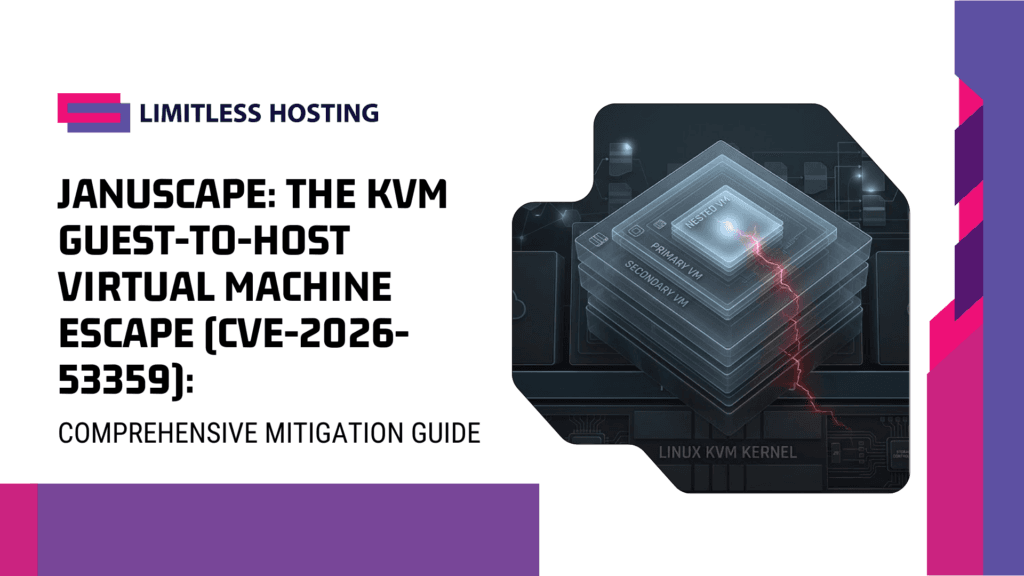
In the hyper-scale cloud ecosystem, virtualization is the foundational bedrock of modern infrastructure. Thousands of digital agencies, SaaS platforms, and enterprise applications rely on the absolute isolation of Virtual Private Servers (VPS) to host their databases, run their APIs, and process transactional records. The absolute premise of this architecture is simple: what happens inside a virtual machine stays inside that virtual machine.
However, a newly disclosed hypervisor-level vulnerability has shattered this assumption.
Dubbed Januscape (CVE-2026-53359), this critical “VM Escape” vulnerability resides directly within the Linux kernel’s KVM (Kernel-based Virtual Machine) subsystem for x86 architectures, affecting both Intel and AMD processors.
Januscape represents an existential threat to multi-tenant cloud environments because it allows a high-privileged user inside a guest virtual machine to break out of their virtualized container and execute malicious, arbitrary code directly on the bare-metal host hypervisor.
Once an attacker escapes the guest VM and gains code execution on the parent host, the entire node is compromised. The attacker can quietly inspect neighboring virtual machine memory volumes, access unencrypted storage arrays, intercept network packets, and gain absolute administrative control over the entire hypervisor.
At Limitless Hosting, we treat technical infrastructure security as our highest operational priority. Whether you manage single databases on our shared servers or run complex systems on your own virtual private environments, understanding and mitigating kernel-level threats like Janusches is essential.
This comprehensive guide explores the deep technical mechanics of the Januscape exploit, its operational impact on multi-tenant web servers, and the step-by-step mitigation paths required to keep your systems secure.
Key Takeaways
Before exploring the technical details of hypervisor exploits, here is an executive summary of the Januscape threat:
- The Ultimate Security Breach: Januscape (CVE-2026-53359) is a guest-to-host escape flaw that breaks the secure sandbox barrier of KVM-based virtualization.
- Hardware-Wide Vulnerability: The exploit targets x86 instruction emulation logic inside the Linux kernel, making physical systems running both Intel and AMD silicon vulnerable.
- Multi-Tenant Exposure: In standard shared or unhardened cloud environments, a single compromised virtual machine running Januscape can expose every neighboring tenant on the physical server.
- No File Modification Required: Like other memory-resident zero-days, Januscape manipulates active hypervisor memory states, bypassing standard local file-integrity scanners.
- Comprehensive Defense-in-Depth: Securing your hypervisor must be matched with active external domain, network, and uptime surveillance to ensure unauthorized system drifts are flagged instantly.
1. What is Januscape? (The Technical Breakdown)
To understand the severity of the Januscape exploit, we must look at how the Linux kernel emulates hardware for virtual machines.
The Role of KVM x86 Instruction Emulation
When you run a Virtual Private Server, the guest operating system believes it is interacting directly with physical hardware (CPUs, network cards, and memory controllers).
In reality, the KVM kernel module, working in tandem with userspace monitors (like QEMU), intercepts specific privileged hardware instructions executed by the guest OS and “emulates” their outcomes.
This interaction is managed through highly complex page-table mappings and hardware-assisted virtualization technologies (such as Intel VT-x and AMD-V).
Under normal operating conditions, the hypervisor acts as an iron curtain. The guest machine is confined to its virtual memory range and has zero awareness of—or access to—the physical host memory space.
The “Janus” Split: Emulation Logic Failure
The vulnerability is named “Januscape” after Janus, the Roman god of transitions, doors, and dualities, because the exploit leverages a split-logic state during hypervisor-level instruction emulation.
The flaw lies in how the KVM subsystem handles nested page table (NPT/EPT) faults when emulating certain complex, non-standard x86 instructions. When a guest CPU executing in VMX/SVM non-root mode triggers a specific instruction sequence while simultaneously manipulating its own guest page tables, a synchronization logic bug occurs:
- KVM’s instruction emulator attempts to read a portion of physical guest memory to process the emulated instruction.
- Simultaneously, a nested page fault occurs, causing KVM to execute page-table lookup logic to resolve the address.
- Due to an out-of-order state validation failure, KVM uses a stale or unvalidated host physical address pointer instead of the guest’s virtual-to-physical mapped address.
By carefully crafting a sequence of instruction payloads that trigger this specific race window, an attacker inside the guest virtual machine can force KVM to read from and write to arbitrary physical memory addresses on the host machine. This allows the guest to rewrite host kernel memory, hijack CPU instruction pointers on the parent node, and execute arbitrary code at the highest host privilege level. You can find the Full Write Up Here.
2. The Danger to Multi-Tenant Hosting Environments
In the web hosting and cloud computing industry, virtualization is the tool that keeps different customers safely separated.
THE MULTI-TENANT ESCAPE THREAT:
[ Compromised Guest VM ] ➔ [ Triggers Januscape (CVE-2026-53359) ] ➔ [ Escapes KVM Sandbox ]
       ➔ [ Controls Host Hypervisor ] ➔ [ Accesses Neighboring VM Databases ]
Build Your Dream Website Today!
Limitless Hosting offers affordable, reliable and most of all, secure hosting solutions.
The Threat to Shared Infrastructure
In standard multi-tenant hosting environments, hundreds of customers share the same physical server. Security is maintained through strict permission layers and kernel caging.
If an attacker compromises a single client’s web application on an unhardened server, their access is usually limited to that specific user directory. However, if the underlying server hypervisor is vulnerable to a guest-to-host VM escape, the security boundary collapses entirely.
An attacker can use cheap, low-level access to run the Januscape exploit, escape the virtual sandbox, and gain root access to the parent hypervisor. Once they control the host, they can access the files, databases, and emails of every other client on that node. This is why hosting on highly secure, hardened platforms is critical. For businesses, developers, and agency owners managing multiple sites, starting with resource-isolated, fully patched cPanel shared hosting containers ensures that your initial testing environments are protected from neighbor risks.
The Threat to VPS Infrastructures
If you run high-traffic applications, database-heavy storefronts, or custom web portals, you likely use Virtual Private Servers to ensure resource isolation.
While a VPS protects you from the performance fluctuations of shared setups, it remains vulnerable to hypervisor-level exploits if the host kernel is unpatched. If your VPS host is vulnerable to Januscape, an attacker who compromises any other VPS on the same physical server node can break into the hypervisor and access your private database volumes, encryption keys, and customer data.
To protect your business from these external multi-tenant exploits, scaling your systems on high-performance, actively managed virtual machines is essential. Deploying your enterprise applications on our secure, SSD-powered virtual networks provides the dedicated hardware and rapid kernel-level security response you need to keep your data isolated. To learn more about our hardware-level isolation features, explore our tailored VPS hosting plans today.
3. How to Check If Your Servers Are Vulnerable
Januscape affects a wide range of Linux kernels running KVM on x86 Intel and AMD hardware. Specifically, the vulnerability affects almost all mainline Linux kernels released prior to May 2026.
To verify if your server or host node is running a vulnerable kernel version, log into your server via SSH and execute the following command in your terminal:
uname -r
If your kernel version is older than the patched security releases deployed in mid-May 2026 (such as kernel versions 6.8.10, 6.6.31, or corresponding enterprise LTS kernel updates), your hypervisor node is actively vulnerable to the Januscape VM escape.
This security alert is especially relevant following recent industry licensing adjustments, including the cPanel price increase 2026, as webmasters and administrators increasingly demand that their hosting platforms provide elite, proactive security response times to match rising licensing costs.
4. Operational Step-by-Step Mitigation Plan
If you operate your own private cloud node, manage dedicated hypervisor hardware, or run virtual machines on unmanaged platforms, you must execute immediate mitigation steps to close the Januscape exploit vector.
Step 1: Ingest and Compile the Latest Security Patches
The only definitive and permanent resolution for Januscape is applying the official Linux kernel patch that corrects the x86 instruction emulation logic.
- On AlmaLinux / RHEL / Rocky Linux:
sudo dnf clean all sudo dnf update kernel -y - On Ubuntu / Debian:
sudo apt-get update sudo apt-get install --only-upgrade linux-image-generic -y
Step 2: Reboot the Physical Host Node
Unlike standard web software updates, hypervisor kernel updates require a system reboot to load the new kernel code into physical system memory. Coordinate a maintenance window with your clients, safely suspend or live-migrate active guest virtual machines, and reboot the parent hypervisor:
sudo reboot
Step 3: Verify the Running Kernel
Once the physical server restarts, log back into the CLI and confirm that the patched kernel is actively running:
uname -a
Verify that your running version matches the secure, patched releases specified in your OS vendor’s security advisory.
5. Live-Patching and Automation for High-Availability Enterprise Clouds
For high-availability enterprises, financial platforms, and scaling web agencies, taking server nodes offline for a reboot is highly problematic. Every minute of scheduled or unscheduled downtime disrupts client transactions, breaks API connections, and devalues your brand’s reliability.
The Power of Rebootless Live-Patching
To maintain continuous uptime while applying critical kernel security patches, enterprise operations deploy live-patching solutions (such as CloudLinux’s KernelCare or Canonical’s Livepatch).
Live-patching tools work by dynamically injecting security hotfixes directly into the active system memory of the running kernel. This allows administrators to apply patches for critical exploits like Januscape, Fragnesia, or Copy Fail in real-time, with zero performance lag, zero reboots, and zero client service disruptions.
Managing Maintenance with Invoicing Automation
If your systems do require physical hardware reboots for maintenance, communicating these windows to your clients is a key operational task. Web hosts and agencies can leverage automated billing and customer management platforms to streamline these communications.
When comparing Blesta vs WHMCS, Blesta stands out as a highly secure, developer-friendly, and lightweight platform that allows you to easily mass-notify users of upcoming security maintenance, organize server suspension rules, and automate provisioning with minimal system overhead, preserving your server’s RAM and CPU resources.
6. Security Integration: Connecting Local Isolation with Real-time Monitoring
Building a resilient, secure online brand requires a multi-layered security strategy. While establishing secure KVM hypervisors, applying kernel patches, and utilizing isolated virtual containers protects your files and databases locally, your digital presence remains highly vulnerable if your external domain routing is left unprotected.
Your domain name is the virtual address book that directs global traffic to your server’s IP address. If an attacker gains unauthorized access to your registrar account or manipulates your external DNS settings, they can redirect your traffic to their own malicious servers. They can then generate their own valid SSL certificates and harvest your client credentials—all while your physical web server sits completely secure, patched, and idle.
To eliminate this critical security blind spot, web professional must build a complete defense-in-depth perimeter that secures both the web host and the domain root.
THE DEFENSE-IN-DEPTH SHIELD:
[ Registry-Level Domain Watch ] ➔ [ Uncompromised DNS Nameservers ] ➔ [ Hardened, Patched Host (Limitless) ]
Proactive External Monitoring with Aepto
By pairing Limitless Hosting’s secure servers with advanced domain intelligence, you build an impenetrable, double-layered shield. We recommend integrating your web presence with Aepto’s advanced threat intelligence.
By utilizing Aepto’s smart global uptime monitoring networks, you run parallel tests across geographic clusters to ensure your website remains reachable and responsive from different global locations.
While Aepto monitors your external DNS boundaries, alerts you to nameserver drifts, and secures your registry locks around the clock, Limitless Hosting ensures your backend directories, MySQL databases, and virtual machines are processed on highly optimized, unthrottled hardware.
By connecting your intelligent external monitoring with robust web servers, you eliminate technical gaps, ensuring any discrepancy—whether it is a server-side resource spike or an external DNS spoofing attempt—is detected and neutralized instantly.
7. How Limitless Hosting Protects Your Web Assets
At Limitless Hosting, we understand that physical hardware security and kernel-level hardening are the cornerstones of your online success. We do not compromise on security, and we actively implement proactive configurations across all our hosting tiers:
Accelerated C++ Control Architectures
To keep your web servers fast and responsive, we minimize administrative system overhead. Our servers utilize DirectAdmin, a lightweight control panel written natively in compiled C++. DirectAdmin consumes up to 80% less system RAM than legacy panels, leaving your CPU and memory free to process your actual web pages and database queries.
To explore the advantages of this lightweight setup, read our guide on why DirectAdmin hosting is the best choice for your website.
Hardware-Isolated Shared Environments
To protect our shared hosting users from “noisy neighbor” resource abuse and directory-browsing exploits, we run CloudLinux OS across our shared nodes. CloudLinux places every shared user account inside its own isolated LightWeight Virtual Environment (LVE) container.
This cage ensures that even if a neighboring account on your physical node is compromised, the attacker is locked in a secure sandbox and cannot see, access, or modify your website files, providing virtual private server-style security at an affordable shared price. To explore these isolated options, review our fast, lean da shared hosting packages.
Dedicated AMD Hardware Platforms
Our virtual servers are built exclusively on enterprise-grade hardware nodes featuring Intel processors. These modern CPUs include native hardware-level security extensions that help isolate virtual machine memory blocks directly at the silicon level, creating a formidable barrier against memory-scraping and guest-to-host hypervisor exploits.
Technical Comparison: Hypervisor Security vs. Container Isolation
| Technical Feature | Shared LVE Containers | KVM Virtual Private Servers (VPS) |
|---|---|---|
| Primary Isolation Layer | Software (CloudLinux OS kernel) | Hardware (KVM Hypervisor / CPU) |
| Kernel Autonomy | Shared (all accounts share the host kernel) | Dedicated (each VPS runs its own OS kernel) |
| Root Access (SSH) | Blocked (user-level directory access only) | Full Root Access (Complete system control) |
| VM Escape Vulnerability | N/A (confined to OS permission limits) | Historically vulnerable (mitigated via rapid patches) |
| Resource Allocation | Shared (throttled via soft/hard LVE limits) | Dedicated (100% reserved hardware lanes) |
| Administrative Complexity | Zero (fully managed by the host) | Medium to High (requires Linux administration) |
Conclusion: Staying Resilient in a Complex Threat Landscape
The discovery of critical virtualization vulnerabilities like Januscape is a stark reminder that internet security requires continuous, proactive effort. Relying on slow, unpatched hosting environments or ignoring the security of your external domain routes represents an unnecessary operational risk.
By keeping your operating systems patched, utilizing hardware-isolated KVM virtualization, leveraging lightweight control panels, and pairing your secure servers with proactive external domain surveillance, you build an ironclad foundation for growth.
At Limitless Hosting, we provide the unthrottled gigabit network ports, enterprise SSD and NVMe storage nodes, lightweight panel integrations, and managed engineering support needed to run your web applications flawlessly. Take back control over your server performance, secure your databases, and scale your digital presence on a hosting platform that is truly limitless.
Frequently Asked Questions (FAQs)
1. Does Januscape affect standard shared web hosting accounts?
Directly, no. Januscape is a hypervisor-level vulnerability that targets the KVM virtualization layer. However, if your shared hosting provider runs their shared nodes on unpatched virtual servers, a breach on the host could indirectly expose your shared files. At Limitless Hosting, we apply immediate kernel patches to protect all our shared and virtual systems.
2. What is the main difference between KVM and OpenVZ virtualization?
KVM (Kernel-based Virtual Machine) is a full virtualization technology, meaning each VPS runs on its own dedicated virtual hardware and operates with its own independent Linux kernel.
OpenVZ is container-based, sharing the physical host’s kernel among multiple containers. KVM provides significantly higher security, isolation, and stability, making it the preferred virtualization choice for business.
3. Can an attacker exploit Januscape from a standard, low-privileged VPS user account?
No. To execute the memory manipulation commands and CPU instruction calls required to trigger the Januscape VM escape, the attacker must already possess administrative or root-level privileges inside the guest virtual machine (the VPS).
However, if an attacker compromises a basic user account and utilizes a local privilege escalation (LPE) exploit (such as Fragnesia or Copy Fail) to gain root, they can then execute the Januscape escape.
4. How does DirectAdmin hosting help mitigate server overhead?
DirectAdmin is written natively in compiled C++, consuming up to 80% less system RAM than legacy Perl-based control panels. This technical efficiency leaves almost your entire server resource pool free to process active web applications, run database queries, and process security protocols, allowing your virtual machines to run smoothly without bottlenecks.
5. Why is KVM virtualization recommended for e-commerce platforms?
E-commerce websites process sensitive credit card transactions and handle heavy databases. A KVM VPS guarantees that your CPU, RAM, and storage are 100% reserved for your business. Because there is zero resource sharing or cross-contamination at the OS level, KVM provides the elite isolation and security required to meet PCI-DSS compliance standards.
6. How does external uptime monitoring support my server security?
Even if your local web servers and databases are completely secure and patched against exploits, your website will go offline if your domain DNS settings are manipulated or your registrar account is hijacked.
Using independent, real-time uptime monitoring from Aepto ensures that any unauthorized changes to your DNS or routing paths are instantly flagged, allowing you to intercept threats before they can damage your business.
Latest Posts:
- How to Choose the Right VPS Without Overspending: 10th Anniversary VPS Offer:
- The Ultimate Guide to Click-to-Call: Turn Website Traffic into High-Converting Phone Leads
- What Is GoHighLevel? Complete Guide for Beginners
- How to Make the Most of Web Hosting Discounts: Limitless Hosting 10th Anniversary Sale
- How to Get Cheaper Web Hosting Without Sacrificing Performance