
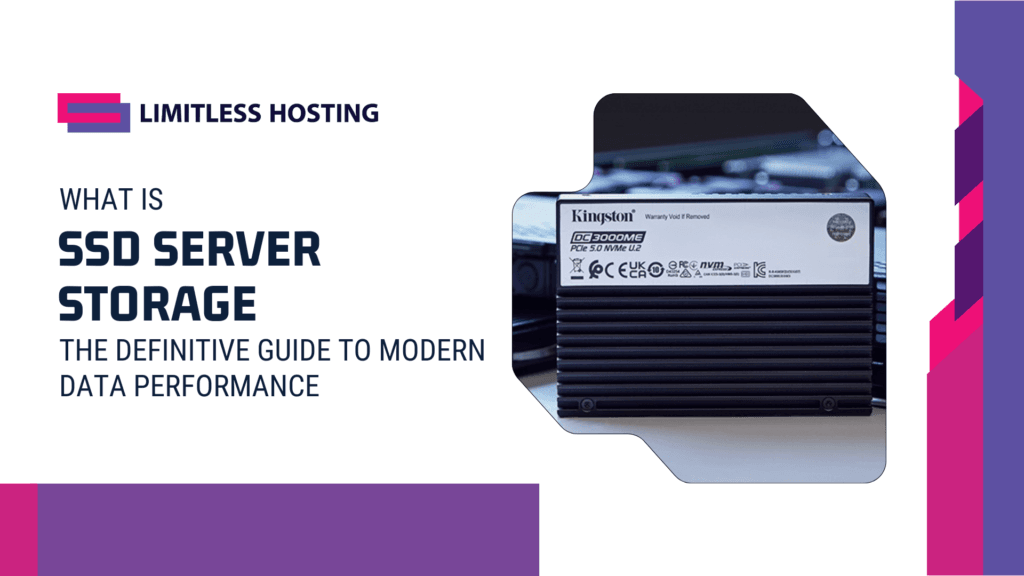
Introduction To SSD Server Storage
In the world of web hosting, speed is the ultimate currency. For decades, the bottleneck of every server was a physical, mechanical limitation: the Hard Disk Drive (HDD). These devices, while revolutionary in their time, relied on spinning platters and moving actuator arms, essentially high-tech record players.
Today, the industry has undergone a total transformation. You might have heard the saying ‘Get SSD Server Storage Hosting’, “Make sure to get Fast SSD Servers”, and you might have thought ‘just what is SSD server storage?’ Well, The mechanical era is over, replaced by the silent, lightning-fast era of Solid State Drives (SSD).
If you are a business owner, a developer, or an agency, understanding SSD server storage is no longer optional. It is the foundation upon which user experience, SEO rankings, and database reliability are built.
In this guide, we will peel back the layers of SSD technology, compare it to legacy hardware, and explain why your choice of storage is the most critical decision in your hosting stack.
The Anatomy of an SSD: How Solid State Logic Works
To appreciate the speed of an SSD, you first have to understand the “moving parts” problem. A traditional HDD has a disk that spins at 7,200 or 15,000 RPM. To read data, a physical head must move to the exact coordinate on that spinning disk. This creates “Seek Time” and “Latency.”
An SSD has no moving parts. It is “Solid State” because the data is stored on interconnected flash memory chips.
NAND Flash Memory
The core of an SSD is NAND Flash Memory. This is a type of non-volatile storage, meaning it retains data even when the power is turned off. Inside these chips, data is stored in “cells.”
- SLC (Single-Level Cell): Stores one bit per cell. It is the fastest and most durable but the most expensive.
- MLC (Multi-Level Cell): Stores two bits per cell. A balance of speed and cost.
- TLC (Triple-Level Cell): Stores three bits per cell. The standard for most modern web servers.
- QLC (Quad-Level Cell): Stores four bits per cell. Used for massive storage arrays where capacity is more important than extreme speed.
At Limitless Hosting, we utilize high-grade enterprise flash to ensure that the endurance of our drives matches the high-demand workloads of our clients. This technical commitment is part of how Limitless Hosting changes the game in web hosting, moving away from the “standard” consumer-grade parts used by budget competitors.
SSD vs. HDD: The Performance Gap Explained
The difference between HDD and SSD isn’t just a slight improvement; it is a generational leap. Let’s look at the metrics that actually matter for your website.
IOPS (Input/Output Operations Per Second)
This is the most critical metric for web hosting. Every time a user visits your site, the server performs dozens of small “reads.”
- Standard HDD: ~80 to 120 IOPS.
- Enterprise SSD: ~10,000 to 100,000+ IOPS.
When hundreds of users hit your site simultaneously, an HDD-based server enters a “Queue.” The disk literally cannot move fast enough to satisfy all requests, leading to the dreaded “Loading…” spinner. An SSD handles these concurrent requests effortlessly.
This is a primary reason why DirectAdmin hosting is the best choice for your website; the control panel and underlying services remain responsive even under heavy load because the I/O wait time is virtually zero.
Throughput and Latency
Throughput is the volume of data moved per second (MB/s), while latency is the delay before data transfer begins. HDDs have high throughput for large, sequential files (like a movie) but terrible latency for the small, random files that make up a website (CSS, JS, small images). SSDs provide near-instant access to these thousands of tiny files.
The NVMe Revolution: Beyond the SATA Bottleneck
When SSDs first entered the server market, they used the SATA (Serial ATA) interface. SATA was designed for HDDs. It was a narrow “pipe” that could only handle about 600 MB/s.
Then came NVMe (Non-Volatile Memory express). NVMe isn’t just a faster drive; it’s a whole new language.
- Direct Connection: NVMe drives plug directly into the PCIe bus (the same lane used by high-end graphics cards).
- Parallelism: While SATA can handle one command queue with 32 commands, NVMe can handle 65,535 queues, each with 64,000 commands.
- The Result: NVMe can reach speeds of 3,500 MB/s to 7,000 MB/s, over ten times faster than a standard SSD.
At Limitless Hosting, we prioritize NVMe for our VPS and Premium hosting tiers because we know that database-heavy sites (like WordPress or E-commerce stores) thrive on this level of performance.
Blazing Fast SSD Powered Hosting Servers!
At Limitless Hosting, we utilize high-grade enterprise flash to ensure that the endurance of our drives matches the high-demand workloads of our clients.
Why SSD Storage is the Secret to SEO Success
Search engines, particularly Google, have made it clear: Speed is a ranking factor. With the introduction of “Core Web Vitals,” metrics like Largest Contentful Paint (LCP) and Time to First Byte (TTFB) directly influence where you appear in search results.
Improving TTFB
TTFB is the time it takes for the server to send the first byte of data back to the browser. If your server is waiting on a slow HDD to find your index file, your TTFB will be poor. Moving to SSD storage is the single most effective way to lower TTFB instantly.
If you are struggling with low rankings for your WordPress site despite having great content, you need to look at how to improve WordPress site speed and if you have SSD on your current server plan. Often, the answer isn’t a new plugin, it’s moving to a server that doesn’t rely on 20th-century mechanical storage.
Reliability: The “Moving Parts” Risk Factor
Servers are high-heat environments. HDDs generate significant heat because they are physically spinning. They are also sensitive to vibrations. If one part of the actuator arm fails, the entire drive (and your data) is gone.
SSDs are significantly more durable. They are resistant to physical shock and operate at much lower temperatures.
This reliability is vital for businesses that cannot afford downtime. At Limitless Hosting, we combine this hardware reliability with proactive monitoring. For example, our AI domain monitoring with Aepto allows us to keep an eye on the digital perimeter, but the physical perimeter is secured by the robust nature of our SSD-only infrastructure.
Impact on Database and Dynamic Content
Modern web development is dynamic. Every page load is a conversation between the web server and a database (MySQL, MariaDB, or PostgreSQL).
The Random Read Problem
In an HDD, a database query requires the “head” to jump around the disk to find different rows of data. This “Random Read” is where HDDs perform at their worst.
In an SSD, there is no “jumping.” Every cell is accessed with the same near-zero latency. This makes complex queries, like those used in WooCommerce for filtering products or in forums for searching posts, happen in milliseconds.
If you run a site with high user interaction, HDD storage isn’t just slow; it’s a liability that will lead to timed-out connections and lost customers.
The Economics of SSD Storage: Cost vs. Value
A common objection to SSD server storage is the price. Yes, a 1TB SSD is more expensive than a 1TB HDD. However, in a server environment, you shouldn’t be measuring “Price per Gigabyte.” You should be measuring “Price per Transaction” or “Price per Visitor.”
Increased Efficiency
Because an SSD-powered server can handle more requests per second, you can actually host a high-traffic site on a smaller, more efficient plan. An HDD server might need 16GB of RAM just to cache enough data to hide the disk’s slowness. An SSD server can often achieve the same performance with half the resources because it doesn’t need to “hide” its storage latency.
Reduced Bounce Rates
A site that loads in 1 second has a bounce rate 3x lower than a site that loads in 5 seconds. If your hosting costs $5 more a month for SSD, but you retain 10% more of your traffic, the SSD has paid for itself within the first few hours of the month.
Common Misconceptions About SSD Storage
“Cloud Storage is always SSD”
False. Many “Big Tech” cloud providers offer tiered storage. Their “Standard” or “Cold” storage is often backed by magnetic HDDs. To get SSD or NVMe, you often have to pay for a “Premium” add-on. At Limitless Hosting, we believe high performance shouldn’t be an “extra”, it should be the standard.
“SSDs wear out too fast”
False (for Servers). While it’s true that SSD cells have a finite number of “writes,” enterprise-grade SSDs are designed for “Write Endurance.” They use advanced techniques like Wear Leveling (distributing writes evenly across the drive) and Over-provisioning (keeping extra cells in reserve to replace old ones). An enterprise SSD will likely outlast the server it is installed in.
“I don’t need SSD for a static site”
False. Even a static HTML site benefits. The web server (LiteSpeed or Nginx) still has to read the files from the disk. More importantly, the security software, the logging services, and the SSL handshake process all rely on disk I/O.
Integrating SSD with Modern Software Stacks
Hardware is only half the battle. To truly unlock the power of SSD storage, your software needs to be optimized for it.
- LiteSpeed Web Server: We use LiteSpeed because its caching engine is designed to take full advantage of the high IOPS provided by our NVMe drives.
- MariaDB Optimization: We tune our databases to minimize unnecessary disk writes, preserving the life of the SSD while maximizing the speed of every query.
- Object Caching (Redis/Memcached): While SSDs are fast, RAM is faster. We combine SSD storage with RAM-based caching to create a multi-tier speed strategy that is nearly unbeatable.
Conclusion: Choosing Your Foundation
Your website is an investment in your brand’s future. Building that investment on legacy HDD storage is like building a skyscraper on a foundation of sand. It might look fine at first, but as soon as the pressure of traffic or the weight of data hits, the cracks will show.
SSD server storage, and specifically NVMe storage, is the only viable choice for the modern web. It provides the speed your users demand, the performance your databases require, and the reliability your business deserves.
At Limitless Hosting, we don’t just provide space on a disk. We provide a high-performance environment engineered for growth. From our DirectAdmin Web Hosting to our Premium VPS nodes, we ensure that SSD performance is at the heart of everything we do.
Don’t let your competitors outpace you because they chose better hardware. Give your website the speed it deserves. Experience the difference that professional, SSD-powered hosting makes today.
FAQ (Frequently Asked Questions)
What is the main difference between SSD and HDD in hosting?
HDDs use mechanical spinning disks; SSDs use flash memory. SSDs are significantly faster, more durable, and better at handling multiple website visitors at once.
Why is NVMe better than standard SSD?
NVMe uses the PCIe bus to communicate directly with the CPU, bypassing the slow SATA interface. It is up to 10 times faster than a regular SATA SSD.
How does SSD storage affect my website’s Google ranking?
Google uses page speed as a ranking factor. SSDs lower your Time to First Byte (TTFB) and improve overall loading times, which helps you rank higher in search results.
Can I upgrade my current HDD hosting to SSD?
Yes. Most modern providers, like Limitless Hosting, offer migration services to move your data from old mechanical drives to modern SSD or NVMe infrastructure.
Read our latest posts:
- How Much Storage Does a WordPress Website Need?
- WordPress Scheduled Posts Not Publishing on Shared Hosting? How to Fix It
- What Can We Expect From CloudFest 2026?
- How Aepto Browser Extension Can Help You Understand a Website’s Hosting Stack
- CloudFest 2025 and Its Impact on Web Hosting & Cloud Infrastructure