
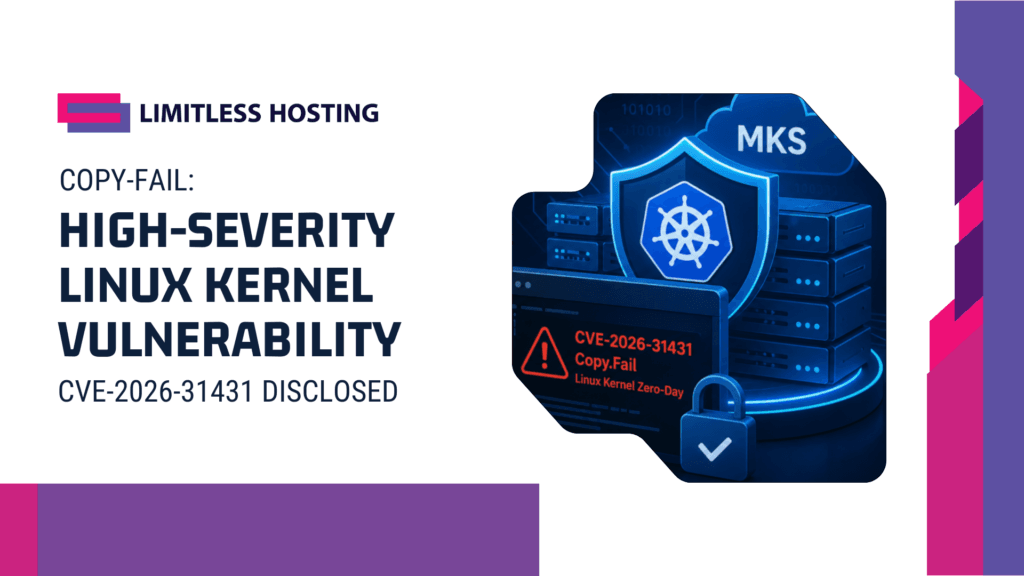
Overview: High-Severity Linux Kernal Vulnerability
A significant security flaw in the Linux kernel, codenamed “COPY-FAIL” and tracked as CVE-2026-31431, has been publicly disclosed. This high-severity vulnerability allows local unprivileged users to gain full root privileges on almost every major Linux distribution released since 2017.
With a CVSS score of 7.8, COPY-FAIL: high-severity linux kernel vulnerability CVE-2026-31431 represents a critical threat to server security, multi-tenant environments, and containerized workloads.
What is the COPY-FAIL Vulnerability?
The COPY-FAIL vulnerability stems from a logic flaw within the Linux kernel’s cryptographic subsystem, specifically the algif_aead module (AF_ALG). The issue was introduced in a source code commit dating back to August 2017, meaning it has remained hidden in the Linux ecosystem for nearly a decade.
The flaw allows an attacker to conduct a Local Privilege Escalation (LPE) by writing four controlled bytes into the page cache of any readable file. By targeting sensitive binaries such as /usr/bin/su or /usr/bin/sudo, an unprivileged user can modify the cached version of the binary in memory to execute arbitrary code as the root user.
Technical Analysis: How CVE-2026-31431 Works
Unlike many traditional exploits that rely on complex race conditions or probabilistic memory corruption, COPY-FAIL is a straight-line logic flaw. It is highly reliable and portable across different kernel versions and distributions.
- The Primitive: The 2017 in-place optimization in algif_aead allows a page-cache page to end up in the kernel’s writable destination scatterlist for an AEAD operation.
- The Mechanism: An unprivileged process can use an AF_ALG socket and drive splice() into that socket. This allows a small, targeted write into the page cache of a file the user does not own but can read.
- The Result: Since the page cache is shared system-wide, a write from a low-level account—or even from within a container—affects the host’s memory, enabling a clean container-escape primitive.
Researchers have already demonstrated a 732-byte Python script that can reliably “root” distributions including Ubuntu, Red Hat Enterprise Linux (RHEL), Amazon Linux, and SUSE.
Blazing Fast Hosting.
Get the speed your website deserves with NVMe storage and optimized server resources.
Impact on Modern Linux Distributions
The reach of COPY-FAIL is extensive due to its presence in the mainline kernel for several years. The following distributions are confirmed to be affected:
| Distribution | Status | Recommended Action |
|---|---|---|
| Ubuntu | Affected | Update to latest patched kernel |
| RHEL / AlmaLinux | Affected | Apply Errata / Kernel Update |
| Amazon Linux | Affected | Patch via AWS Update channels |
| CloudLinux | Affected | Apply KernelCare or manual update |
One of the most dangerous aspects of COPY-FAIL is its impact on container security. Because the page cache is shared between the host and containers, an attacker in a compromised container can potentially compromise the entire host kernel.
How to Mitigate COPY-FAIL (CVE-2026-31431)
Security experts and distribution maintainers are rapidly releasing patches. The most effective long-term solution is to update the system kernel to a version that includes the fix for CVE-2026-31431.
Temporary Workaround
If an immediate kernel update is not possible, administrators can blacklist the algif_aead module to prevent its registration at boot. Note that standard modprobe blacklisting may not work if the module is built-in; instead, use grubby to update kernel boot parameters:
sudo grubby –update-kernel=ALL –args=”initcall_blacklist=algif_aead_init”
sudo reboot
This mitigation disables the AEAD AF_ALG interface, closing the attack surface. Most common applications like SSH, OpenSSL (default builds), and IPsec do not rely on this specific interface and will continue to function normally.
Limitless Hosting: Proactive Protection and Secured Infrastructure
At Limitless Hosting, we prioritize the security of our infrastructure and our customers’ data. Following the disclosure of CVE-2026-31431, our security team took immediate action to protect all managed services.
What we have done:
- Immediate Mitigation: We have already applied the necessary mitigations, including kernel blacklisting where applicable, across our entire managed server fleet.
- Automated Patching: Our systems have been updated with the latest secure kernel versions as they became available from upstream vendors.
- Hardened Security: By managing the underlying infrastructure, Limitless Hosting ensures that vulnerabilities like COPY-FAIL are neutralized before they can be exploited.
Our customers using premium DirectAdmin Hosting or Reseller Hosting can rest assured that their servers are secured against the COPY-FAIL exploit. If you are looking for a hosting partner that treats zero-day vulnerabilities with the urgency they deserve, Limitless Hosting provides the expertise and proactive management needed to keep your business online and safe.
Conclusion
COPY-FAIL (CVE-2026-31431) is a reminder of the persistence of deep-seated logic flaws in complex software like the Linux kernel. While the vulnerability is severe, the availability of reliable mitigations and rapid vendor patches provides a clear path to safety.
System administrators should prioritize kernel updates and consider managed hosting solutions like Limitless Hosting to stay ahead of the evolving threat landscape.
Additionally, for those looking to secure their brand assets or find expired domains with AI, our partners at Aepto provide additional layers of digital protection.
Frequently Asked Questions (FAQ)
1. Is COPY-FAIL exploitable remotely?
No. COPY-FAIL is a Local Privilege Escalation (LPE). An attacker must already have the ability to run code on the system (e.g., via a shell, a compromised web application, or a container) to exploit it.
2. Does this affect Docker and Kubernetes?
Yes. This is perhaps the most dangerous aspect of the flaw. Because Docker and Kubernetes share the host’s kernel and page cache to optimize memory, an attacker with limited access inside a container can use COPY-FAIL to modify host binaries in memory, gaining root access on the underlying host machine.
3. Will blacklisting algif_aead break my VPN or SSH?
In 99% of cases, no. Most modern software (like OpenSSH or WireGuard) uses userspace cryptographic libraries like OpenSSL or Sodium rather than the kernel’s AF_ALG interface. However, some niche high-performance storage or networking tools that offload encryption to the kernel might see a performance dip or fail.
4. How does this compare to “Dirty Pipe”?
COPY-FAIL is functionally similar to the 2022 “Dirty Pipe” (CVE-2022-0847) vulnerability in that it allows overwriting read-only file data in the page cache. However, COPY-FAIL is considered more “stable” across a wider range of kernel versions (5.x and 6.x) and is harder to detect with standard memory-monitoring tools.
5. Can I detect if someone has exploited this on my server?
Since the exploit modifies the page cache (in-memory) and not the file on the physical disk, standard file integrity tools like AIDE or Tripwire may not detect the change immediately. You would need to perform memory forensics or check kernel audit logs for suspicious splice() calls to AF_ALG sockets.
6. Does this affect Android?
Yes, Android devices running kernels from 2017 onwards (Version 4.14+) are theoretically vulnerable. Users should look for the May 2026 Security Patch level to ensure they are protected.
7. Are Limitless Hosting customers at risk?
We have already applied proactive mitigations across our shared hosting and reseller hosting platforms. Our managed infrastructure is protected by real-time kernel patching that does not require a reboot for our customers.
Read more:
- How Aepto Browser Extension Can Help You Understand a Website’s Hosting Stack
- CloudFest 2025 and Its Impact on Web Hosting & Cloud Infrastructure
- How Long Do Web Hosting Anniversary Discounts Last?
- Why Domain Monitoring Matters for Brand Protection
- Why Do People Attend CloudFest? 10 Reasons the Internet Infrastructure Community Shows Up